







Actinemys pallida, 134
Actinemys pallida (Seeliger 1945) –
Southwestern Pond Turtle, Tortuga de Poza
David J. Germano1, R. Bruce Bury2,
and Jorge H. Valdez-Villavicencio3
1Department of Biology, California State University at Bakersfield,
Bakersfield, California 93311 USA [[email protected]];
21410 NW 12th Street, Corvallis, Oregon 97330 USA [[email protected]];
3Conservación de Fauna del Noroeste, A.C., Jorge Mazón 291, Ampliación Punta Banda,
Ensenada, Baja California 22897 Mexico [[email protected]]
Summary. – The Southwestern Pond Turtle, Actinemys pallida (family Emydidae) occurs in western North America from Baja California, Mexico, north through the Coast Range to the Monterey Bay area south of San Francisco, California, USA. A recent genetic study elevated this former subspecies of A. marmorata to species status. The species generally grows to 130–180 mm straight-line carapace length (SCL). It occurs in a variety of permanent and intermittent aquatic habitats, including rivers, streams, lakes, creeks, ponds, marshes, vernal pools, and human-constructed ponds associated with wastewater and cattle watering-tanks from sea level up to ca. 1,240 m (4,080 ft) in elevation. Hatchlings are 20–36 mm SCL and adult males grow to 179 mm SCL and females to 164 mm SCL. Females produce 2–11 eggs in a clutch and double clutching occurs. Much of the core area of the range of the species is in the highly populated Los Angeles Basin and in southern California, and many populations have as a result been lost, although populations are robust in the upper mountain reaches extending into the Los Padres National Forest in Ventura County. North of Santa Barbara, the species is more secure because of the less dense human population and more rural habitat extending to the northern edge of the range in the Monterey Bay region. The primary threats to the species are loss and alteration of both aquatic and terrestrial habitats as well as, potentially, climate change causing prolonged droughts. These losses fragment remaining populations and may magnify the effects of introduced species through predation, competition, and epidemic disease(s). The turtle is listed as a Species of Special Concern in California and is being considered for federal listing by the U.S. Fish and Wildlife Service. Research is ongoing on many aspects of its ecology and status, but many of the studies are unpublished. Greater effort is needed to protect and manage its aquatic habitats as well as nesting and overwintering sites in adjacent uplands.
Distribution. – Mexico, USA. The species occurs from northern Baja California, Mexico, north through the Coast Range to Monterey Bay, California, south of San Francisco, USA. The northern and southeastern boundaries are uncertain because turtles in the San Francisco Bay Area and along the southern edge of the Transverse Range in Los Angeles County have an admixture of both A. pallida and A. marmorata genes. Pure A. pallida occurs from the southern end of Monterey Bay south into Baja California, with disjunct populations in the westernmost Mojave Desert.
Synonymy. – Clemmys marmorata pallida Seeliger 1945; Actinemys marmorata pallida; Emys marmorata pallida; Emys pallida, Actinemys pallida.
Subspecies. – None recognized.
Status. – IUCN 2026 Red List (in press): Endangered (EN A2ce+4ce, E), assessed 2024; IUCN 2025 Red List: Vulnerable (VU A1cd [ver. 2.3]), assessed 1996 as part of Actinemys marmorata; CITES: Not Listed; California: Species of Special Concern: US ESA: Candidate Threatened Species (USFWS 2025)
Citation:
Germano, D.J., Bury, R.B., and Valdez-Villavicencio, J.H. 2026. Actinemys pallida (Seeliger 1945) – Southwestern Pond Turtle, Tortuga de Poza. In: Rhodin, A.G.J., Iverson, J.B., van Dijk, P.P., Stanford, C.B., Goode, E.V., Buhlmann, K.A., and Mittermeier, R.A. (Eds.). Conservation Biology of Freshwater Turtles and Tortoises: A Compilation Project of the IUCN SSC Tortoise and Freshwater Turtle Specialist Group. Chelonian Research Monographs 5(20):134.1–17. doi: 10.3854/crm.5.134.pallida.v1.2026; www.iucn-tftsg.org/cbftt/.
Download pdf
Adobe Acrobat 6.0 or later required)
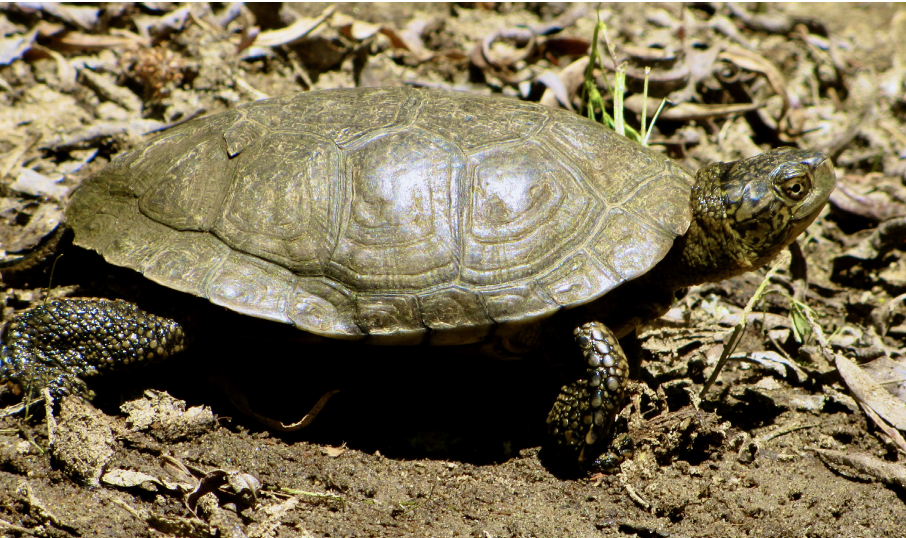
Adult male Southwestern Pond Turtle, Actinemys pallida, from Arroyo San Rafael, Baja California, Mexico.
Photo by Jorge H. Valdez-Villavicencio.
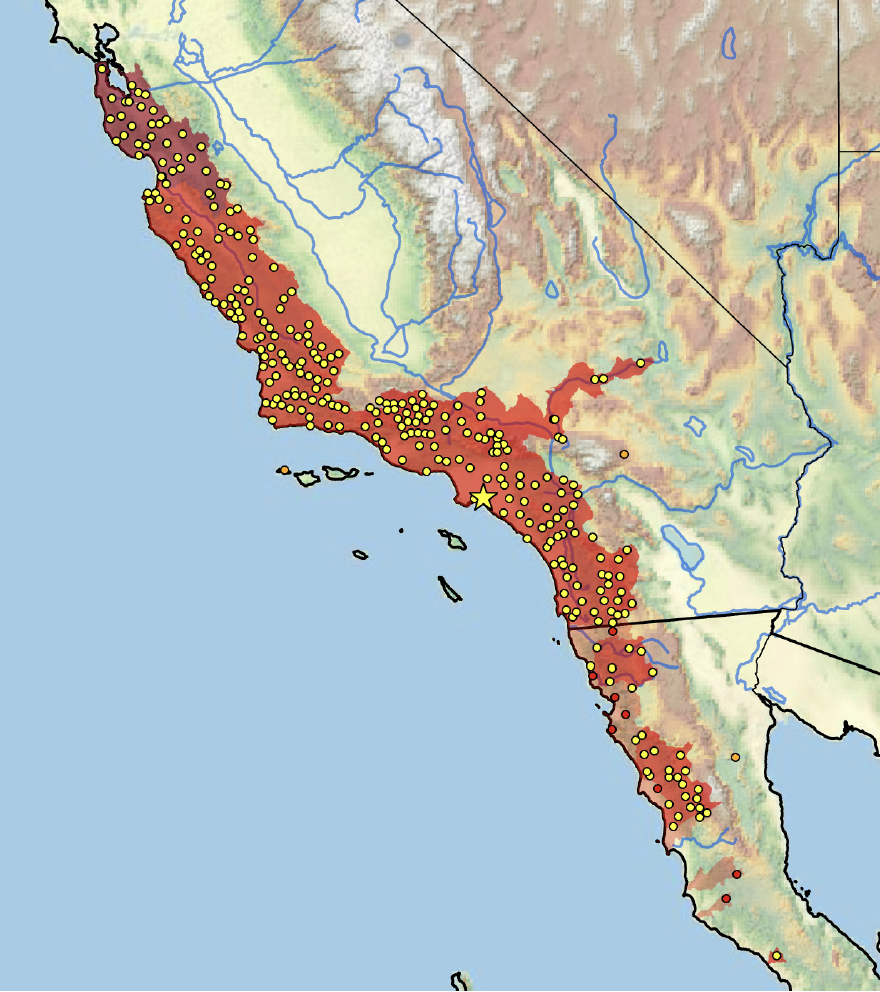
Distribution:
Estimated historical indigenous distribution of Actinemys pallida in California, USA, and Baja California, Mexico. Yellow dots = museum and current and historical occurrence records of presumed native populations based on literature and online records (TTWG 2025); orange dots = probable non-native introductions, translocations, or erroneous records; red dots = apparently extirpated populations; star = type locality. Colored shading = estimated historical indigenous range (dark red = extant; light red = apparently extirpated; purple = approximate area of partial hybridization with A. marmorata). Distribution is based on fine-scaled GIS-defined level 12 HUCs (hydrologic unit compartments) constructed around verified localities and then adding HUCs that connect known point localities in the same watershed or physiographic region, and similar habitats and elevations as verified HUCs, and further adjusted based on data from the literature and the authors. Map by Chelonian Research Foundation.
Previous CBFTT Account:
Bury and Germany (2008) as part of Actinemys marmorata (Account 001)
(Download pdf)