







Macrochelys suwanniensis, 133
Macrochelys suwanniensis Thomas, Granatosky, Bourque, Krysko,
Moler, Gamble, Suarez, Leone, Enge, and Roman 2014 – Suwannee Alligator Snapping Turtle
Travis M. Thomas1, Kevin M. Enge2, Dirk J. Stevenson3, and Gerald R. Johnston4
1Department of Wildlife Ecology and Conservation, Nature Coast Biological Station,
University of Florida, 110 Newins-Ziegler Hall, Gainesville, Florida 32611 USA [[email protected]];
2Fish and Wildlife Research Institute, Florida Fish and Wildlife Conservation Commission,
1105 SW Williston Road, Gainesville, Florida 32601 USA [[email protected]];
3Altamaha Environmental Consulting, 414 Club Drive,
Hinesville, Georgia 31313 USA [[email protected]];
4Department of Natural Sciences, Santa Fe College, 3000 NW 83rd Street,
Gainesville, Florida 32606 USA [[email protected]]
Summary. – The Suwannee Alligator Snapping Turtle, Macrochelys suwanniensis (family Chelydridae), is a large, aquatic freshwater species that is genetically and morphologically distinct from other Macrochelys populations. The species is endemic to the Suwannee River drainage in southern Georgia and northern Florida, where it occupies the mainstem Suwannee River and most of its larger streams and tributaries. However, it is considered rare in the headwaters, including the extreme upper Suwannee River and Okefenokee Swamp. A capture-recapture study in the mainstem Suwannee River suggests high annual adult apparent survival (0.99) and estimated the population size to be ~1,200–2,700 individuals (~7 turtles per river km). Despite these findings, the population trend is considered uncertain, potentially stable or slightly declining. Population structure, sex ratios, densities, and mean body size vary across sites, likely reflecting natural variation in riverine habitat and resources availability in the Suwannee drainage. Males tend to reach much larger sizes in the more biologically productive sections of the Suwannee and Santa Fe rivers. The high proportion of large males (≥45 kg) indicates that the Suwannee drainage was likely spared from past commercial and local overharvest, which has plagued other Macrochelys populations. A study in the upper and middle sections of the Suwannee River found home range size to be individually variable and temporally dynamic in response to water levels. Turtles move linearly within the river channel and utilize bank-associated habitats such as woody debris and undercut banks, but during flooded conditions, turtles move laterally into the floodplain, likely to access new resources that are generally unavailable. Reproductive biology and diet remain poorly understood but may resemble those of M. temminckii, the Western Alligator Snapping Turtle. Although possession and harvest are illegal, incidental mortality from ingested fishing hooks and entanglement in bank-set fishing gear poses a significant threat to populations. Recent research indicates that ~10% of radiographed individuals were found to have ingested fishing hooks lodged in the throat or gastrointestinal tract, potentially posing a significant health risk. This is an immediate conservation concern because M. suwanniensis populations can rapidly decline due to small increases in adult mortality. Over the long-term, increasing water withdrawals, decreasing water quality, and frequent sewage spills represent emerging threats to population persistence. Macrochelys suwanniensis is considered Threatened in both Florida and Georgia, and recently the U.S. Fish and Wildlife Service also listed the species as federally Threatened under the Endangered Species Act.
Distribution. – USA. Endemic to the Suwannee River drainage in southern Georgia and northern peninsular Florida.
Synonymy. – Macrochelys suwanniensis Thomas, Granatosky, Bourque, Krysko, Moler, Gamble, Suarez, Leone, Enge, and Roman 2014.
Subspecies. – None recognized.
Status. – IUCN 2025 Red List: Vulnerable (VU C1; assessed 2025); CITES: Appendix II (USA, as Macrochelys temminckii [sensu lato]; assessed 2023); US ESA: Threatened (assessed 2024); Florida: Threatened; Georgia: Threatened.
Citation:
Thomas, T.M., Enge, K.M., Stevenson, D.J., and Johnston, G.R. 2025. Macrochelys suwanniensis Thomas, Granatosky, Bourque, Krysko, Moler, Gamble, Suarez, Leone, Enge, and Roman 2014 – Suwannee Alligator Snapping Turtle. In: Rhodin, A.G.J., Iverson, J.B., van Dijk, P.P., Stanford, C.B., Goode, E.V., Buhlmann, K.A., and Mittermeier, R.A. (Eds.). Conservation Biology of Freshwater Turtles and Tortoises: A Compilation Project of the IUCN/SSC Tortoise and Freshwater Turtle Specialist Group. Chelonian Research Monographs 5(19):133.1–20. doi: 10.3854/crm.5.133.suwanniensis.v1.2025; www.iucn-tftsg.org/cbftt/.
Adobe Acrobat 6.0 or later required)
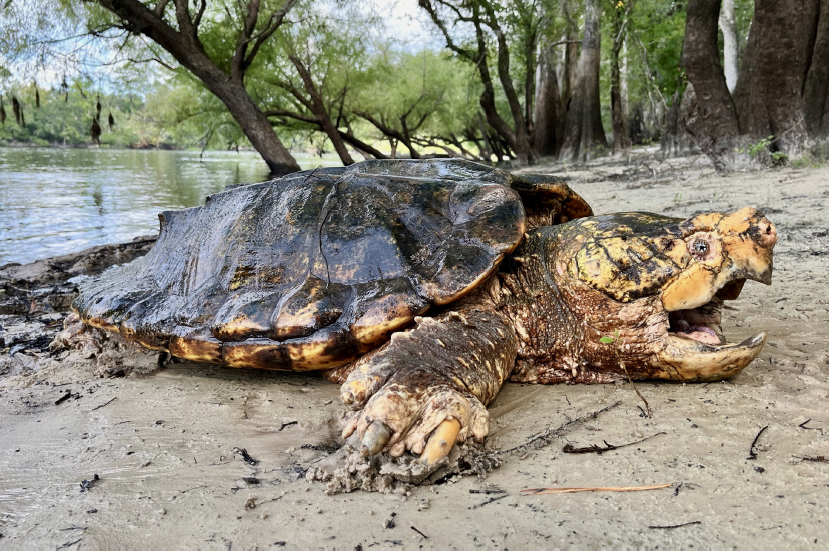
Adult male Macrochelys suwanniensis (CL = 627 mm) from the Rock Bluff Spring, Suwannee River, Florida, USA.
Photo by Kevin M. Enge.
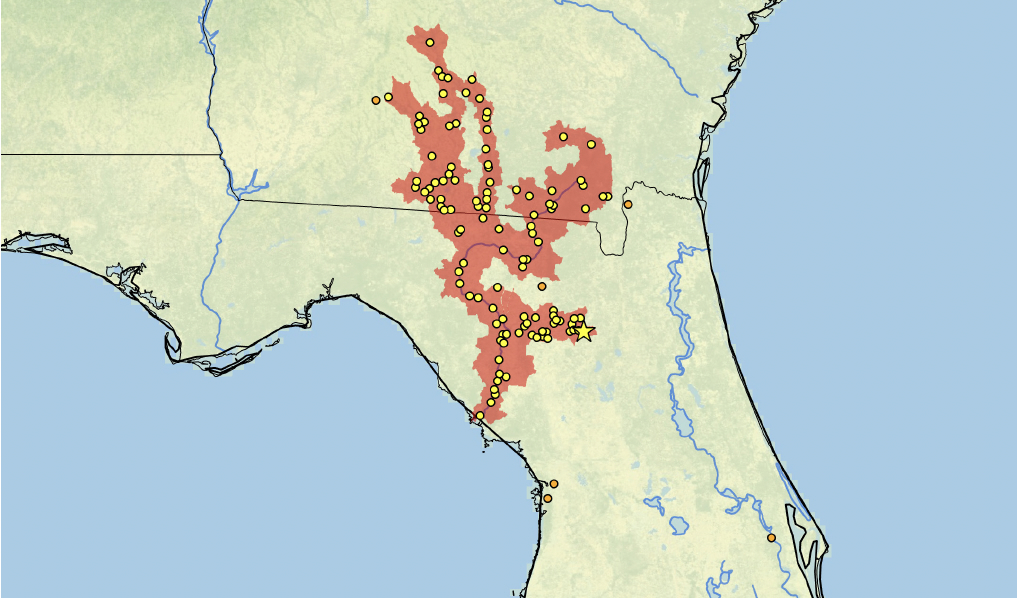
Distribution:
Estimated historical indigenous distribution of Macrochelys suwanniensis in Florida and Georgia, southeastern USA. Yellow dots = museum and current and historical occurrence records of presumed native populations based on literature and online records (TTWG 2025); orange dots = probable non-native introductions, translocations, or erroneous records; star = type locality. Colored shading = estimated historical indigenous range. Distribution is based on fine-scaled GIS-defined level 12 HUCs (hydrologic unit compartments) constructed around verified localities and then adding HUCs that connect known point localities in the same watershed or physiographic region, and similar habitats and elevations as verified HUCs, and further adjusted based on data from the literature and the authors. Map by Chelonian Research Foundation.