




Hydromedusa maximiliani, 136
Hydromedusa maximiliani (Mikan 1825) –
Brazilian Snake-necked Turtle, Maximilian’s Snake-necked Turtle,
Cágado-da-Serra, Cágado-Pescoço-de-Cobra
Shirley Famelli1 and Franco Leandro Souza2
1University of Bristol, Faculty of Science, School of Geographical Sciences,
Bristol, United Kingdom [[email protected]];
2Universidade Federal de Mato Grosso do Sul, Instituto de Biociências,
Campo Grande, Mato Grosso do Sul, Brazil [[email protected]]
Summary. – Maximilian’s Snake-necked Turtle or the Brazilian Snake-necked Turtle, Hydromedusa maximiliani (family Chelidae), is a relatively small freshwater turtle species, with male and female straight-line carapace lengths (SCL) up to 203 mm and 169 mm, respectively. The species occurs primarily in higher-elevation lotic environments, and is endemic to the Atlantic rainforest of southeastern and eastern Brazil, inhabiting streams and rivers in hilly terrain, often using submerged logs, rocks, and streambank crevices as refuges. Individuals are largely sedentary, although males and gravid females exhibit large seasonal movements associated with reproductive periods. Clutch size ranges from 1–3 eggs, but usually two. The species is carnivorous, feeding on aquatic macroinvertebrates, crustaceans, insects, and other small prey, as well as carrion. Habitat loss from deforestation, mining, burning, and pollution are major threats, and populations from outside protected areas are more vulnerable to decline. Conservation efforts need to focus on habitat protection and monitoring of populations.
Distribution. – Brazil. Endemic to hilly regions of the southeastern and eastern Brazilian Atlantic Rainforest, occurring in Bahia, Espírito Santo, Minas Gerais, Rio de Janeiro, and São Paulo.
Synonymy. – Emys maximiliani Mikan 1825, Chelodina maximiliani, Hydromedusa maximiliani, Hydraspis maximiliani; Emys maximiliana Gray 1830 (nomen novum), Hydromedusa maximiliana; Chelodina flavilabris Duméril and Bibron 1835, Hydromedusa flavilabris, Chelomedusa flavilabris; Hydromedusa subdepressa Gray 1854; Hydromedusa depressa Gray 1856 (nomen novum), Chelomedusa depressa; Hydromedusa bankae Giebel 1866.
Subspecies. – None recognized.
Status. – IUCN 2026 Red List: Endangered (EN A2ce+4ce; assessed 2023 [in press]); Previously: Vulnerable (VU, assessed 1996); CITES: not listed; Brazil: Least Concern (LC) (national), LC (São Paulo); VU (Minas Gerais); VU (Espírito Santo); EN (Bahia).
Citation:
Famelli, S. and Souza, F.L. 2026. Hydromedusa maximiliani (Mikan 1825) – Brazilian Snake-necked Turtle, Maximilian’s Snake-necked Turtle, Cágado-da-Serra, Cágado-Pescoço-de-Cobra. In: Rhodin, A.G.J., Iverson, J.B., van Dijk, P.P., Stanford, C.B., Goode, E.V., Buhlmann, K.A., and Mittermeier, R.A. (Eds.). Conservation Biology of Freshwater Turtles and Tortoises: A Compilation Project of the IUCN/SSC Tortoise and Freshwater Turtle Specialist Group. Chelonian Research Monographs 5(20):136.1–12. doi: 10.3854/crm.5.136.maximiliani.v2.2026; www.iucn-tftsg.org/cbftt/.
Download pdf
Adobe Acrobat 6.0 or later required)
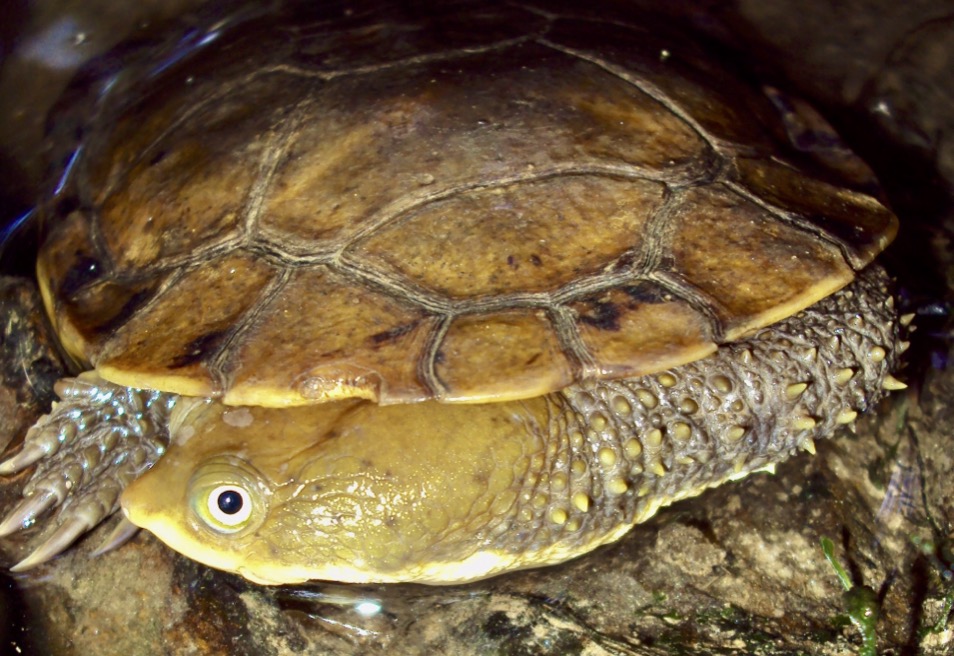
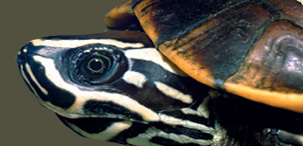
Adult female Maximilian’s Snake-necked Turtle (Hydromedusa maximiliani) from Parque Estadual Carlos Botelho, São Paulo, Brazil,
showing details of its long neck with conical protuberances and the large recessed nuchal scute.
Photo by Shirley Famelli.
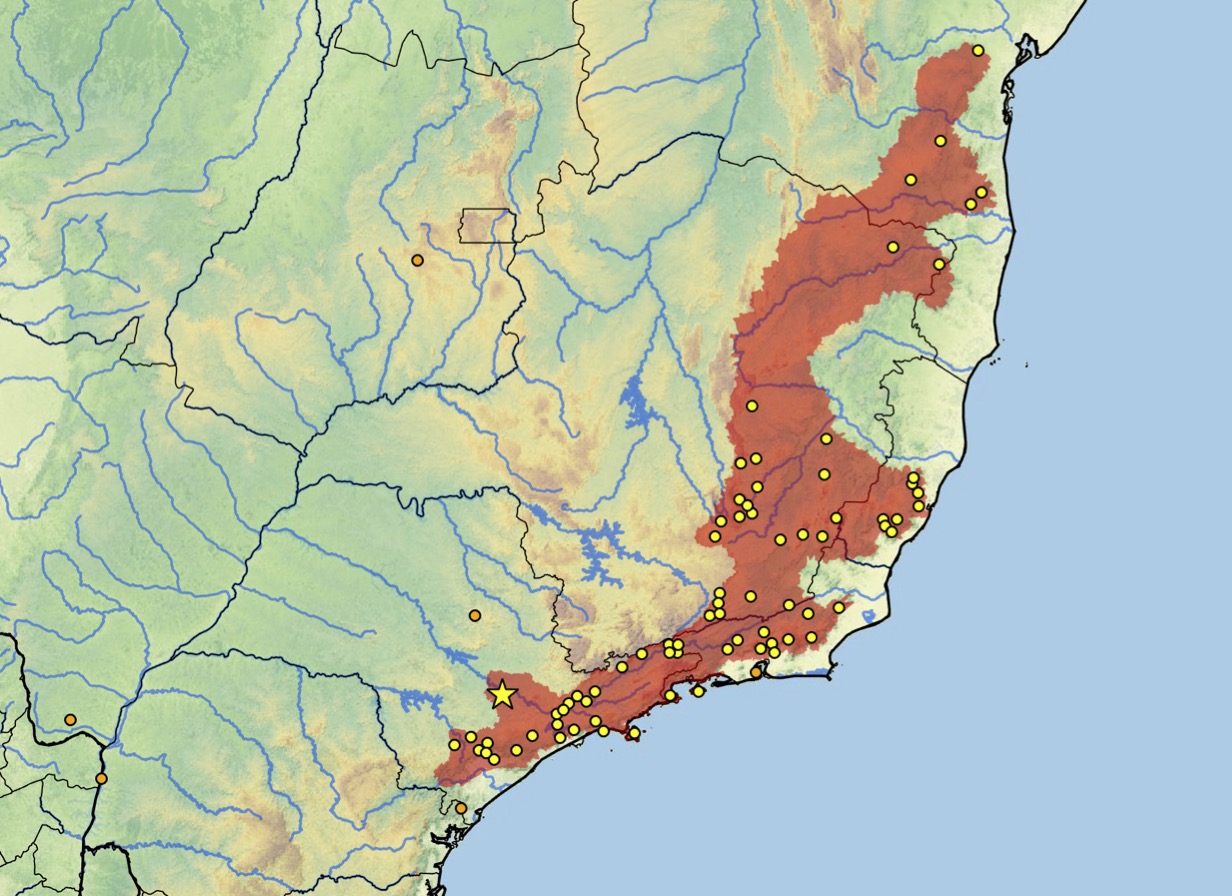
Distribution:
Estimated historical indigenous distribution of Hydromedusa maximiliani in Brazil, including parts of northeastern, southern, eastern, and southeastern coastal regions, with records in Bahia, Espírito Santo, Minas Gerais, Rio de Janeiro, and São Paulo. Yellow dots = museum and current and historical occurrence records of presumed native populations based on literature and online records (TTWG 2025); orange dots = probable non-native introductions, translocations, or erroneous records; yellow star = type locality for Emys maximiliani (Mikan 1825; TTWG 2025). Colored shading = estimated historical indigenous range. Distribution is based on fine-scaled GIS-defined level 12 HUCs (hydrologic unit compartments) constructed around localities and then adding HUCs that connect point localities in the same watershed or physiographic region, and similar habitats and elevations as verified HUCs, based on TTWG (2021, 2025) and adjusted based on data from the authors. Map by Chelonian Research Foundation.
Previous CBFTT Account:
Souza and Martins (2009) Hydromedusa maximiliani (Account 026)
(Download pdf)