








Kinosternon angustipons, 137
Kinosternon angustipons Legler 1965 –
Narrow-Bridged Mud Turtle, Tortuga Pequeña,
Tortuga Fantasma, Pecho Quebrado, Pecho en Cruz
Eric C. Munscher1,2, Rafael Acuña-Mesén3, Andriws E. Bello-Suazo2,4,5,
Nicol Azcona-Orellana4, Rafael Acuña-Castillo3,6,7,
Russell A. Mittermeier8, Andrew D. Walde2, and Anders G.J. Rhodin9,10
1SWCA Environmental Consultants, 10245 West Little York Road, Suite 600,
Houston, Texas 77040, USA [[email protected]];
2Turtle Survival Alliance, 5900 Core Road, Suite 504,
North Charleston, South Carolina 29406, USA [[email protected]];
3School of Biology, University of Costa Rica, Ciudad Universitaria Rodrigo Facio,
San Pedro de Montes de Oca, San José, Costa Rica.[[email protected]];
4Turtle Love Costa Rica, Parismina, Limon, Costa Rica [[email protected]];
5Universidad Técnica Nacional, Sede Atenas, Alajuela, Costa Rica;
6Herbario Luis A. Fournier Origgi (USJ), Centro de Investigación en Biodiversidad y Ecología Tropical (CIBET), Universidad de Costa Rica, San Pedro de Montes de Oca, 11501-2060, San José, Costa Rica [[email protected]];
7Centro de Investigación Jardín Botánico Lankester, Universidad de Costa Rica, 302-7050 Cartago, Costa Rica;
8Re:wild, P.O. Box 129, Austin, Texas 78767, USA [[email protected]];
9Chelonian Research Foundation, 564 Chittenden Drive, Arlington, Vermont 05250, USA [[email protected]];
10Turtle Conservancy, PO Box 1289, Ojai, California 93024, USA
Summary. – The Narrow‑bridged Mud Turtle, Kinosternon (Cryptochelys) angustipons (family Kinosternidae), is a small, poorly known freshwater turtle endemic to the Caribbean lowlands of southeastern Nicaragua, northeastern and southeastern Costa Rica, and northwestern Panama. It is distinguished morphologically by its extremely narrow plastral bridge, reduced plastral kinesis, and cranial and shell characters that separate it from other Central American Kinosternon. Females are only slightly larger than males,with maximum straight-line carapace length (SCL) in females reaching 13.3 cm, and 13.0 cm in males. The species is known from remarkably few localities, occurs at low densities, and exhibits a highly fragmented distribution. Recent field studies have expanded knowledge of the species’ ecological breadth, documenting its presence across a range of natural and anthropogenically altered wetland habitats, including lagoon systems, stagnant streams, and wetlands in degraded cattle pastures and agricultural monocultures. Despite this apparent ecological flexibility, encounter rates remain consistently low, and available evidence indicates a declining population trend driven primarily by habitat loss, hydrological alteration, pollution, and limited collection for the international pet trade. Little is known about the reproductive ecology, survivorship, or population dynamics of wild populations, and available data suggest low fecundity and slow life history typical of kinosternid turtles. As a result, K. angustipons requires conservation planning that relies heavily on newly acquired ecological data rather than historical baselines. The species was previously assessed as Vulnerable on the IUCN Red List in 1996 and was re-assessed as Vulnerable in 2023, although considered possibly Endangered; it has also recently been included in CITES Appendix II. The species needs focused research, and may well need habitat protection and other measures to prevent further declines, as well as a long-term monitoring program.
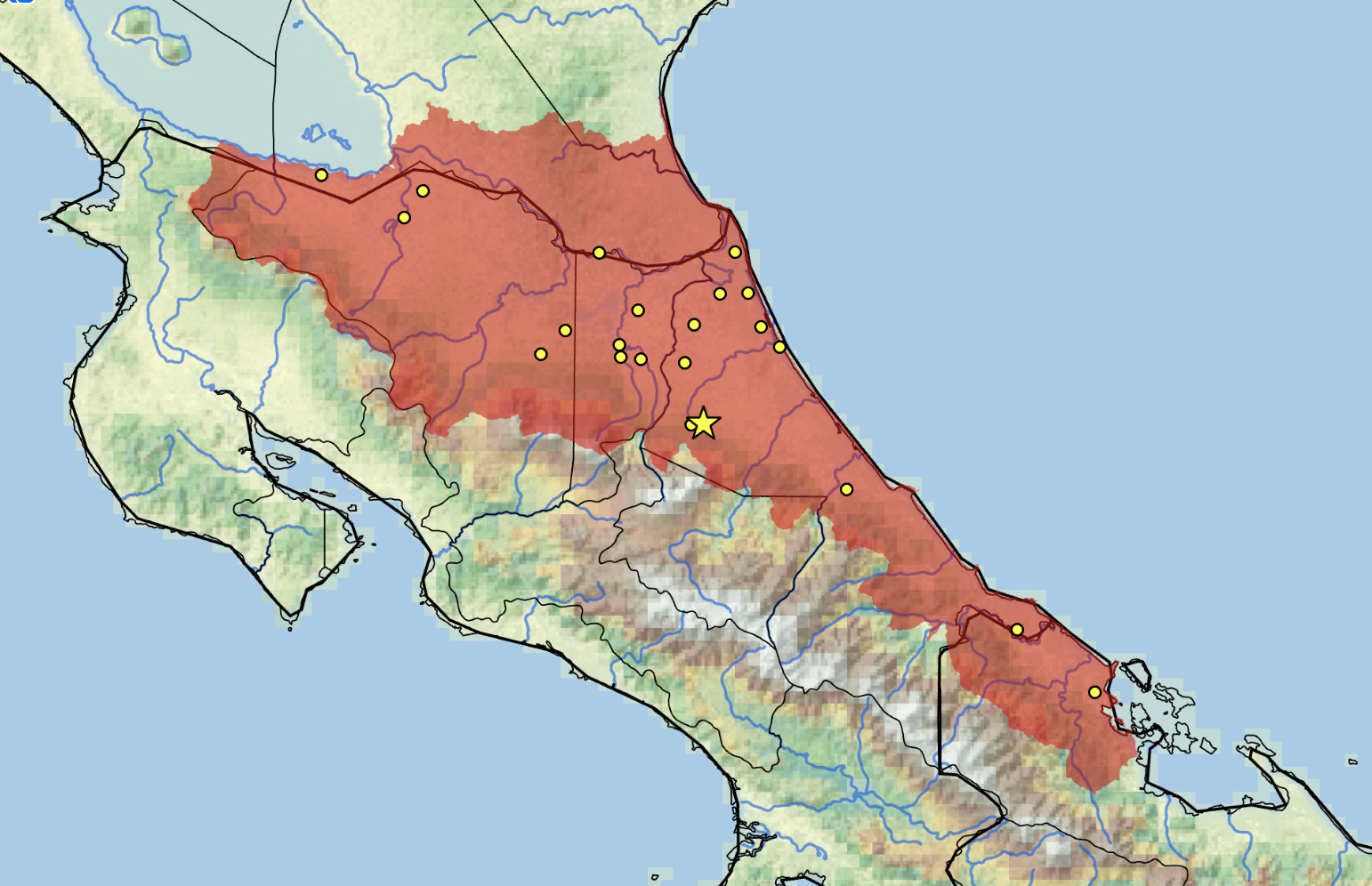
Distribution. – Costa Rica, Nicaragua, Panama. Native to the low elevation plains of the Caribbean versant of southern Central America from southeastern Nicaragua to northwestern Panama.
Synonymy. – Kinosternon angustipons Legler 1965, Cryptochelys angustipons, Kinosternon (Cryptochelys) angustipons.
Subspecies. – None recognized.
Status. – IUCN 2026 Red List: Vulnerable (VU B2ab(ii,iii,iv)), assessed 2026); CITES: Appendix II, as part of Kinosternon spp. (2023).
Citation:
Munscher, E.C., Acuña-Mesén, R., Bello-Suazo, A.E., Azcona-Orellana, N., Acuña-Castillo, R., Mittermeier, R.A., Walde, A.D., and Rhodin, A.G.J. 2026. Kinosternon angustipons Legler 1965 – Narrow-Bridged Mud Turtle, Tortuga Pequeña, Tortuga Fantasma, Pecho Quebrado, Pecho en Cruz. In: Rhodin, A.G.J., Iverson, J.B., van Dijk, P.P., Stanford, C.B., Goode, E.V., Buhlmann, K.A., and Mittermeier, R.A. (Eds.). Conservation Biology of Freshwater Turtles and Tortoises: A Compilation Project of the IUCN/SSC Tortoise and Freshwater Turtle Specialist Group. Chelonian Research Monographs 5(20):137.1–10. doi: 10.3854/crm.5.137.angustipons.v1.2026; www.iucn-tftsg.org/cbftt/.
Download pdf
Adobe Acrobat 6.0 or later required)

Adult male Narrow-bridged Mud Turtle, Kinosternon angustipons, from Puerto Viejo de Sarapiqui, Heredia Province, Costa Rica.
Photo by Rio Dante.
Distribution:
Estimated historical indigenous distribution of Kinosternon angustipons in Nicaragua, Costa Rica, and Panama. Yellow dots = museum and current and historical occurrence records of presumed native populations based on literature and online records (TTWG 2025); yellow star = type locality (Legler 1965; TTWG 2025). Colored shading = estimated historical indigenous range. Distribution is based on fine-scaled GIS-defined level 12 HUCs (hydrologic unit compartments) constructed around localities and then adding HUCs that connect point localities in the same watershed or physiographic region, and similar habitats and elevations as verified HUCs, based on TTWG (2021, 2025) and adjusted based on data from the authors.
Map by Chelonian Research Foundation.