
Summary
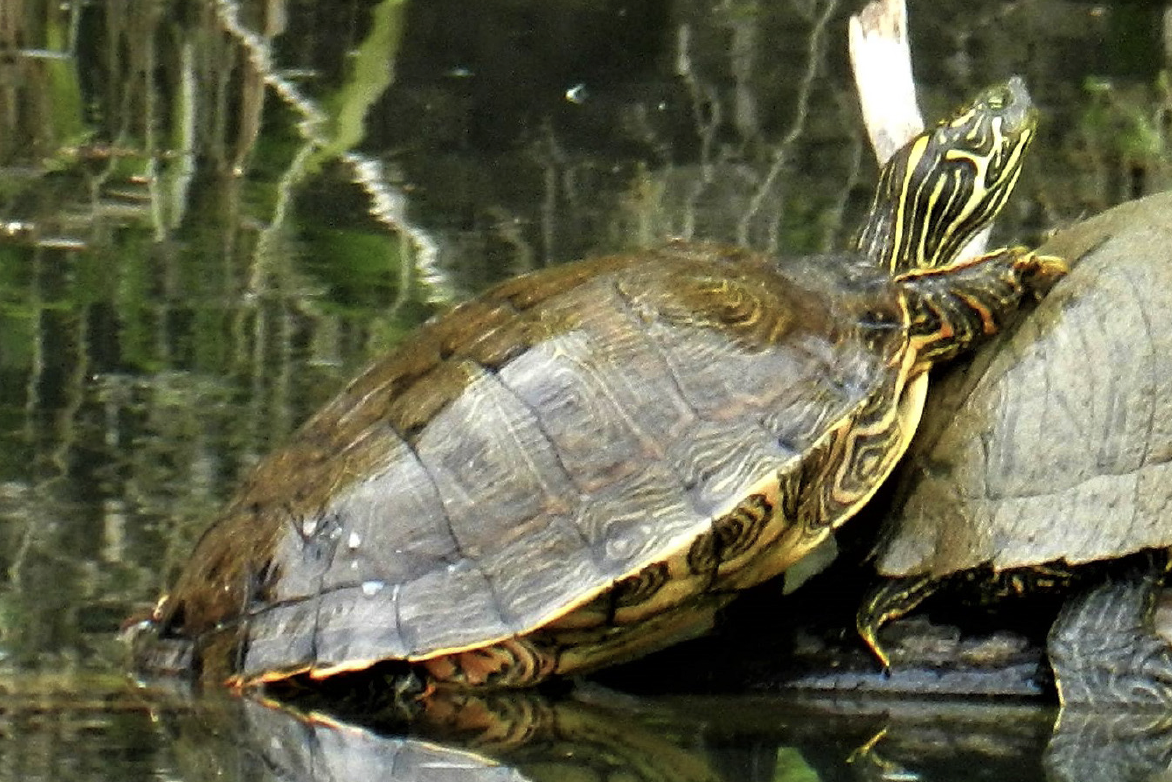
The Texas Cooter, Pseudemys texana (family Emydidae), is a large-bodied, primarily herbivorous freshwater turtle endemic to central and south-central Texas, USA. Maximum recorded straight-line carapace length (SCL) is 29.4 cm for males and 34.4 cm for females. The species exhibits pronounced female-biased sexual dimorphism, rapid juvenile growth, and delayed maturity, characteristics typical of long-lived freshwater turtles. Males attain sexual maturity at approximately 15.4 cm SCL and about 4.4 years of age, whereas females mature at approximately 24.2 cm SCL and about 7.2 years of age. Nesting occurs primarily from late March through summer, with most activity concentrated in April through June. Females typically produce one to two clutches annually, although some individuals are capable of producing three clutches within a season. Clutch size ranges from 3 to 22 eggs, with most clutches containing approximately 8 to 10 eggs. Eggs average about 42 mm in length and 27 mm in width, and incubation periods generally range from 80 to 150 days depending on environmental conditions. Hatchlings are typically about 35 to 40 mm SCL at emergence and exhibit the bright green coloration and distinct yellow striping characteristic of juvenile river cooters. The species is strongly associated with rivers and spring-fed systems but also occurs in reservoirs, impoundments, canals, and stock ponds where aquatic vegetation is abundant. Life-history information is best known from long-term studies at Spring Lake in the San Marcos River headwaters and from surveys at Comal Springs–Landa Lake. These studies document high local abundance, nest-site fidelity, multiple clutching, and substantial spatial and demographic variation among populations. Recent mark-recapture studies and growth modeling have further quantified somatic growth patterns, maturity schedules, and population dynamics. Pseudemys texana, like its counterparts in the genus, has been documented attaining exceptionally high densities in spring-fed headwater systems. The species is currently assessed as Least Concern on the IUCN Red List, but localized threats include alteration of river flow regimes and shorelines, degradation of water quality, increasing recreational pressure and boat strikes, loss of nesting habitat, subsidized nest predation, commercial and pet-trade pressures affecting freshwater turtles in Texas, and emerging infectious diseases.
Distribution
USA. Endemic to Texas; occurs in the Brazos, Colorado (including the Concho, Llano, and San Saba), Guadalupe, San Antonio, and Nueces watersheds.
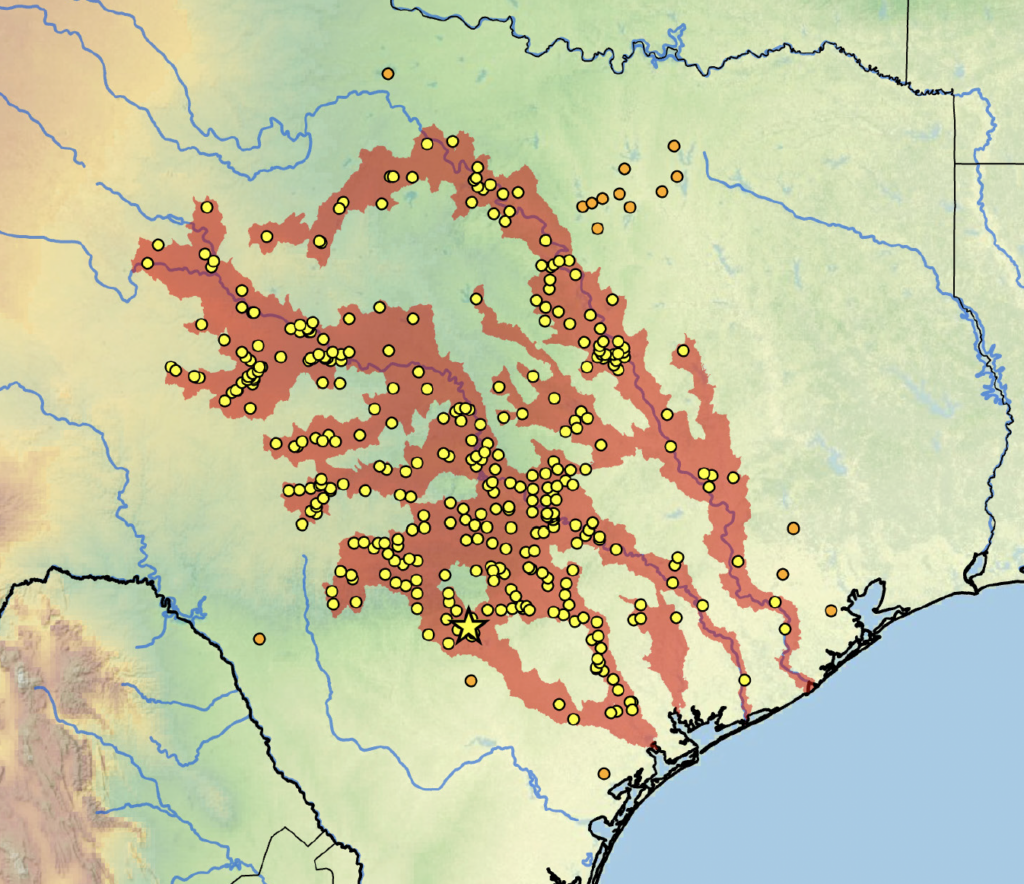
Estimated historical indigenous distribution of the Texas Cooter, Pseudemys texana, in Texas, USA. Yellow dots = museum and current and historical occurrence records of presumed native populations based on literature and online records (TTWG 2025); orange dots = presumed translocated or introduced non-native records; yellow star = type locality for Pseudemys texana Baur 1893. Colored shading = estimated historical indigenous range. Distribution is based on fine-scaled GIS-defined level 12 HUCs (hydrologic unit compartments) constructed around localities and then adding HUCs that connect point localities in the same watershed or physiographic region, and similar habitats and elevations as verified HUCs, based on TTWG (2025) and adjusted based on subsequent data from the authors. Map by Chelonian Research Foundation.
Synonymy
Pseudemys texana Baur 1893, Chrysemys texana, Pseudemys floridana texana, Pseudemys concinna texana, Chrysemys concinna texana.
Subspecies
None recognized. The species was at times in the past considered a subspecies of either Pseudemys floridana or Pseudemys concinna.
Conservation Status
Last Updated on: 23 October 2026
Legal Status
Last Updated on: 23 October 2026
Citation
Ross, S., Munscher, E.C., Gordon, M., Siders, Z.A., Owen, E.C., Rose, F.L., and Walde, A.D. 2026. Pseudemys texana Baur 1893 – Texas Cooter, Texas River Cooter. In: Rhodin, A.G.J., Iverson, J.B., van Dijk, P.P., Stanford, C.B., Goode, E.V., Buhlmann, K.A., and Mittermeier, R.A. (Eds.). Conservation Biology of Freshwater Turtles and Tortoises: A Compilation Project of the IUCN/SSC Tortoise and Freshwater Turtle Specialist Group. Chelonian Research Monographs 5(20):144.1–13. doi: 10.3854/crm.5.144.texana.v1.2026; www.iucn-tftsg.org/cbftt/.