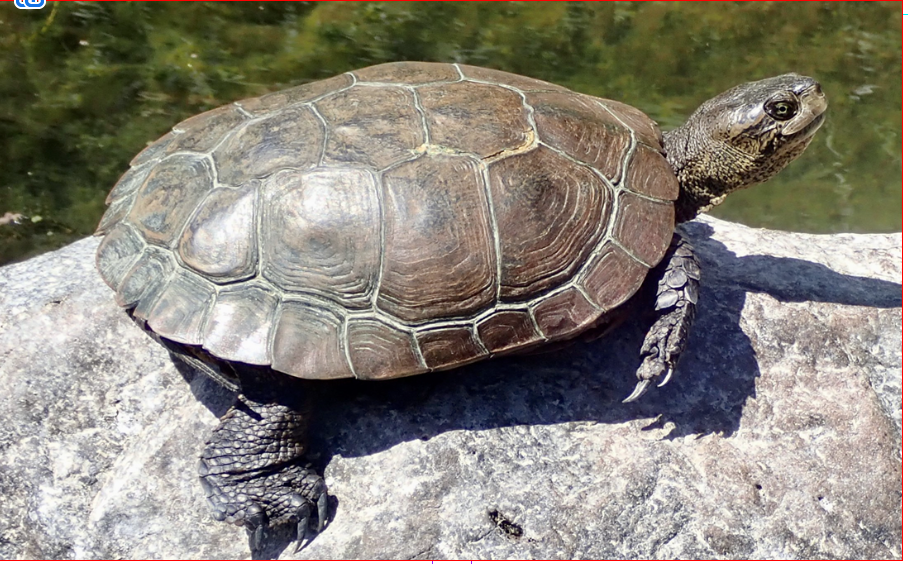
Adult female Actinemys marmorata basking on an emergent boulder in the Rogue River, Josephine County, Oregon.
Photo by Don T. Ashton.
Summary
The Northwestern Pond Turtle, Actinemys marmorata (family Emydidae), currently ranges from northern Washington State through western Oregon and south to central California, USA. It may have formerly ranged from southwestern British Columbia, Canada, but is now likely extirpated or was possibly introduced there. It was recently split from the Southwestern Pond Turtle (A. pallida) that has its range in central coastal California south to Baja California, Mexico. Adult A. marmorata are medium-sized freshwater turtles with a usual straightline (maximum) carapace length (SCL) of 150–180 mm, although some males exceed 220 mm SCL. They are primarily aquatic during their activity period that spans from spring through early fall. They prefer quiet waters, including marshes, ephemeral wetlands, ponds, streams, and rivers as well as artificial water bodies such as canals, cattle ponds, and reservoirs. Some populations persist in intermittent waters present for only 4–6 mo each year. Overwintering habits vary, with most turtles residing in flowing waters moving to upland sites, while others may remain in still waters year-round. They are generalist omnivores, although juveniles primarily feed on invertebrates while adults may include aquatic plants in the diet. Males begin to display secondary sexual characteristics (SSC) by 120 mm SCL while females mature around 140 mm SCL. Individuals tend to grow more slowly in the northern portions of their range where ambient temperatures are lower and the growing season is shorter. In Oregon and northern California, males attain SSC at 6–10 yrs old and females begin to reproduce by about 10 yrs of age. In southern populations, males may attain SSC at 2–4 yrs and females as early as 4 yrs of age. Sex ratios typically are close to 1:1. Most populations have 30–60% of turtles <12 yrs old. Annual survivorship of adults is > 0.7 but this needs better documentation. Survivorship of eggs and hatchlings is low. Mean clutch size is usually from 4.5 to 8.5 eggs (range 2–13), depending on geographic location and environmental conditions. Eggs are typically 32–42 mm long and 18–25 mm wide. Most nesting occurs in late May to mid-July. Double clutching is known in some populations but appears to be ≤5%. The species exhibits temperature-dependent sex determination, with warmer temperatures (≥29°C) producing a higher proportion of females. Current evidence suggests that hatchlings tend to remain in the nest chamber through the winter and emerge in early spring. Populations appear to be declining in the northern portions of its range, near urban centers, and at some remote locations. Robust populations remain in the core of its range in southern Oregon and northern California as well as in some rural and agricultural areas in the southern range. The primary threats are habitat loss, alteration, and fragmentation of both aquatic and terrestrial habitats. Introduced species also pose threats through predation, competition, and disease transmission. Historically, A. marmorata was collected for the food and pet trades; these practices have been outlawed, although the level of continued illegal collection is not known. Greater effort is needed to protect and manage aquatic habitats as well as nesting and overwintering sites in adjacent uplands.
Distribution
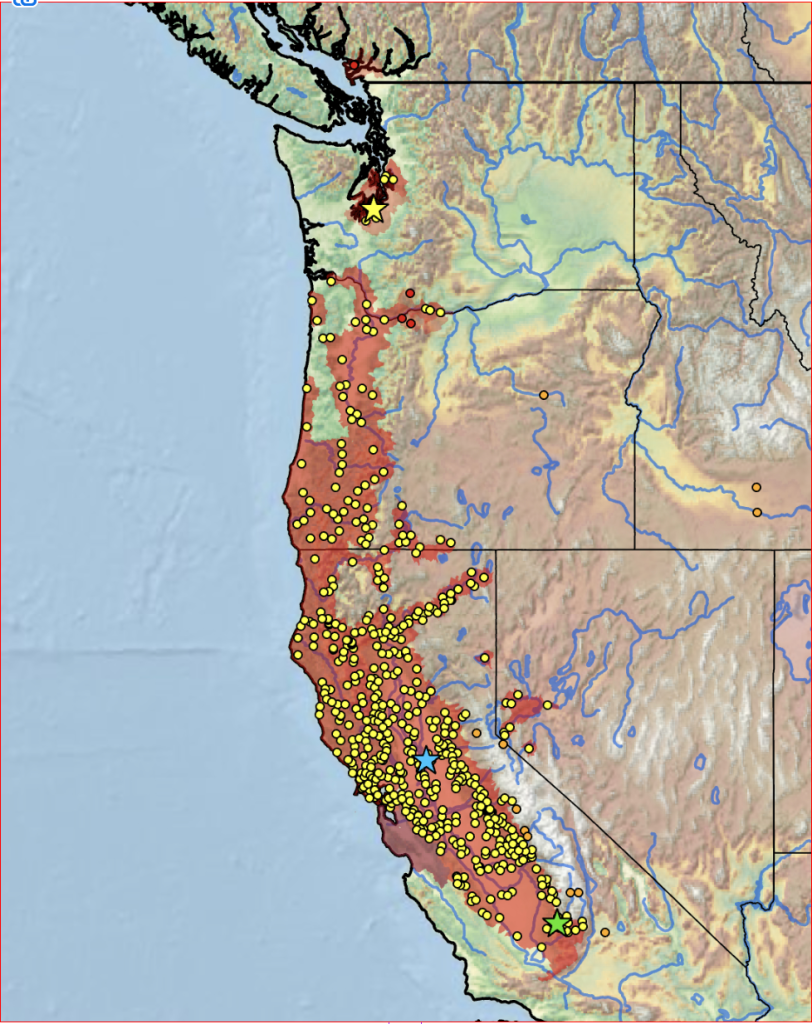
USA. Pacific coast states from northwestern Washington, western Oregon, northern, central, and southern Central Valley of California, with a few isolated populations in western Nevada. Possibly native (or introduced) in extreme southwestern British Columbia, Canada, but now apparently extirpated.
Estimated historical indigenous distribution of Actinemys marmorata in Washington, Oregon, and California, USA, and British Columbia, Canada. The native range is predominantly west of the Sierra Nevada and Cascade mountainous crests. A few populations are found east of the mountains, including western Nevada. Yellow dots = museum and current and historical occurrence records of presumed native populations based on literature and online records (TTWG 2025); orange dots = probable non-native introductions, translocations, or erroneous records; red dots = apparently extirpated populations; stars = type localities (yellow = Emys marmorata; green = Emys nigra; blue = Clemmys wosnessenskyi). Colored shading = estimated historical indigenous range (dark red = extant; light red = apparently extirpated; purple = approximate area of partial hybridization with A. pallida). Distribution is based on fine-scaled GIS-defined level 12 HUCs (hydrologic unit compartments) constructed around verified localities and then adding HUCs that connect known point localities in the same watershed or physiographic region, and similar habitats and elevations as verified HUCs, and further adjusted based on data from the literature and the authors. Map by Chelonian Research Foundation.
None currently recognized (formerly two recognized: Actinemys marmorata marmorata and Actinemys marmorata pallida).
Conservation Status
IUCN 2026 Red List (in press): Vulnerable (VU A2bcde+4bce, E), assessed 2024; IUCN 2025 Red List: Vulnerable (VU A1cd [ver. 2.3]), assessed 1996
Legal Status
CITES: Not Listed; California: Species of Special Concern; Oregon: Sensitive Critical; Washington: Endangered; US ESA: Proposed Threatened.
Citation
Bury, R.B., Germano, D.J, and Ashton, D.T. 2026. Actinemys marmorata (Baird and Girard 1852) – Northwestern Pond Turtle. In: Rhodin, A.G.J., Iverson, J.B., van Dijk, P.P., Stanford, C.B., Goode, E.V., Buhlmann, K.A., and Mittermeier, R.A. (Eds.). Conservation Biology of Freshwater Turtles and Tortoises: A Compilation Project of the IUCN/SSC Tortoise and Freshwater Turtle Specialist Group. Chelonian Research Monographs 5(20):135.1–36. doi: 10.3854/crm.5.135.marmorata.v2.2026; www.iucn-tftsg.org/cbftt/.
Author Information
11410 NW 12th Street, Corvallis, Oregon, 97331 USA [[email protected]];
2Department of Biology, California State University at Bakersfield,
Bakersfield, California, 93311 USA (retired) [[email protected]];
3Applied River Sciences, 980 7th Street, Arcata, California, 95521 USA [[email protected]]
Cookie Consent
We use cookies to improve your experience on our site. By using our site, you consent to cookies.