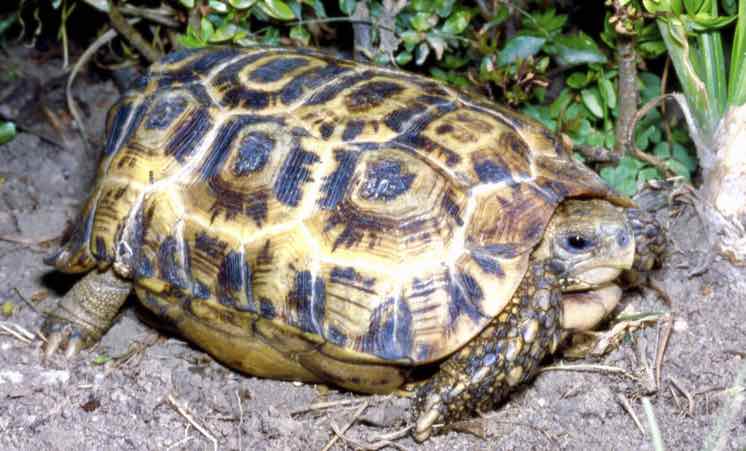
Adult female Speke's Hinged Tortoise (Kinixys spekii) from Dinedor Farm, Eswatini, with bright semi-radial carapacial pattern. Photo by R.C. Boycott.
Summary
Speke's Hinge-back Tortoise, Kinixys spekii (Family Testudinidae), is a medium-sized terrestrial species with an average straight carapace length (SCL) of ca. 130–180 mm, with a maximum SCL of 181 mm for males and 210 mm for the slightly larger females. The species is widespread in the savannahs of the central plateau areas of Africa south of the Equator; it inhabits grassland, bushed and wooded grassland, and woodland such as Miombo and Mopane. A morphological distinction of Kinixys from other tortoise genera is the carapacial hinge; K. spekii has a depressed carapace, with the ratio of shell length to height usually more than 2.3. Carapace scutes usually have a concentric or zonary color pattern, but adult males are often uniform. Clutch size is 2–6 eggs, mean 3.8; egg size is large, mean 31 x 41 mm and 23 g. Annual survival of adults is relatively low (0.74), with high mortality from mammalian and avian predators, especially the Ground Hornbill. Population density is low (0.16/ha) in undisturbed areas. The diet is omnivorous, with 47% vascular plants, 41% fungi, and 12% invertebrates. Fungi are the preferred food, and give the greatest energy intake, but K. spekii shows true diet mixing, taking other food types for other nutrients. Mean body temperature is a relatively low 27.0ºC, giving a wide safety margin before overheating. Seasonal activity is limited by rainfall and food supply, and daily activity is limited by high temperature. The species has entered local and international trade, but remains relatively common even in densely human-populated areas; disturbed areas may have higher population densities due to a lack of predators. Kinixys spekii is protected in many National Parks and Game Reserves throughout its wide range. Captive husbandry is recorded, and improved conservation legislation, such as inclusion in nationally protected faunas, is suggested, in addition to ongoing monitoring of native populations and national and international trade.
Distribution
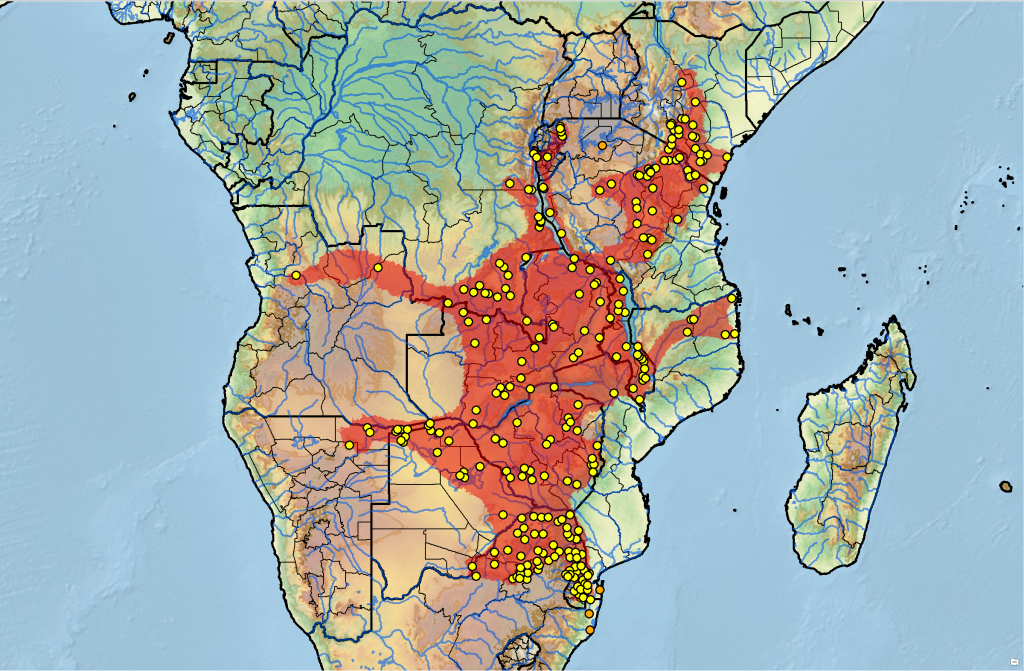
Angola, Botswana, Burundi, Congo (DRC), Eswatini, Kenya, Malawi, Mozambique, Namibia, Rwanda, South Africa, Tanzania, Zambia, Zimbabwe. The species ranges from the savannahs of Rwanda, Tanzania and southern Kenya south to Eswatini and KwaZulu-Natal in South Africa, west to southeastern Democratic Republic of Congo, northern Angola, northeastern Namibia, Zambia, northern Botswana, and Zimbabwe.
Distribution of Kinixys spekii in Africa in Angola, Botswana, Burundi, Congo (DRC), Eswatini, Kenya, Malawi, Mozambique, Namibia, Rwanda, South Africa, Tanzania, Zambia, and Zimbabwe. Yellow dots = museum and literature occurrence records of native populations based on Iverson (1992), Broadley (1993), Boycott (2014), TTWG (2017, 2021), Ihlow et al. (2019), and authors' more recent data; orange dots = possible trade, introduced, or misidentified specimens; red shading = presumed native historic indigenous range. Distribution based on GIS-defined level 12 HUCs (hydrologic unit compartments) constructed around verified localities and then adding HUCs that connect known point localities in the same watershed or physiographic region, and similar habitats and elevations as verified HUCs (Buhlmann et al. 2009; TTWG 2017, 2021) and adjusted based on authors' data.
IUCN Red List: Not Evaluated (NE); TFTSG Provisional Red List: Vulnerable (VU, assessed 2013)
Legal Status
CITES: Appendix II, as Testudinidae spp.
Citation
Hailey, A., Broadley, D.G., Boycott, R.C., and Spawls, S. 2021. Kinixys spekii Gray 1863 – Speke's Hinge-back Tortoise, Speke's Hinged Tortoise. In: Rhodin, A.G.J., Iverson, J.B., van Dijk, P.P., Stanford, C.B., Goode, E.V., Buhlmann, K.A., and Mittermeier, R.A. (Eds.). Conservation Biology of Freshwater Turtles and Tortoises: A Compilation Project of the IUCN/SSC Tortoise and Freshwater Turtle Specialist Group. Chelonian Research Monographs 5(15):115.1–14. doi: 10.3854/crm.5.115.spekii.v1.2021; www.iucn-tftsg.org/cbftt/.
Author Information
1Department of Life Sciences, The University of the West Indies,
St. Augustine, Trinidad and Tobago [[email protected]];
2Natural History Museum of Zimbabwe, P.O. Box 240, Bulawayo, Zimbabwe [Deceased];
3P.O. Box 5245, Mbabane, Eswatini [[email protected]];
47 Crostwick Lane, Spixworth, Norwich NR10 3PE, England [[email protected]]
Cookie Consent
We use cookies to improve your experience on our site. By using our site, you consent to cookies.