Summary
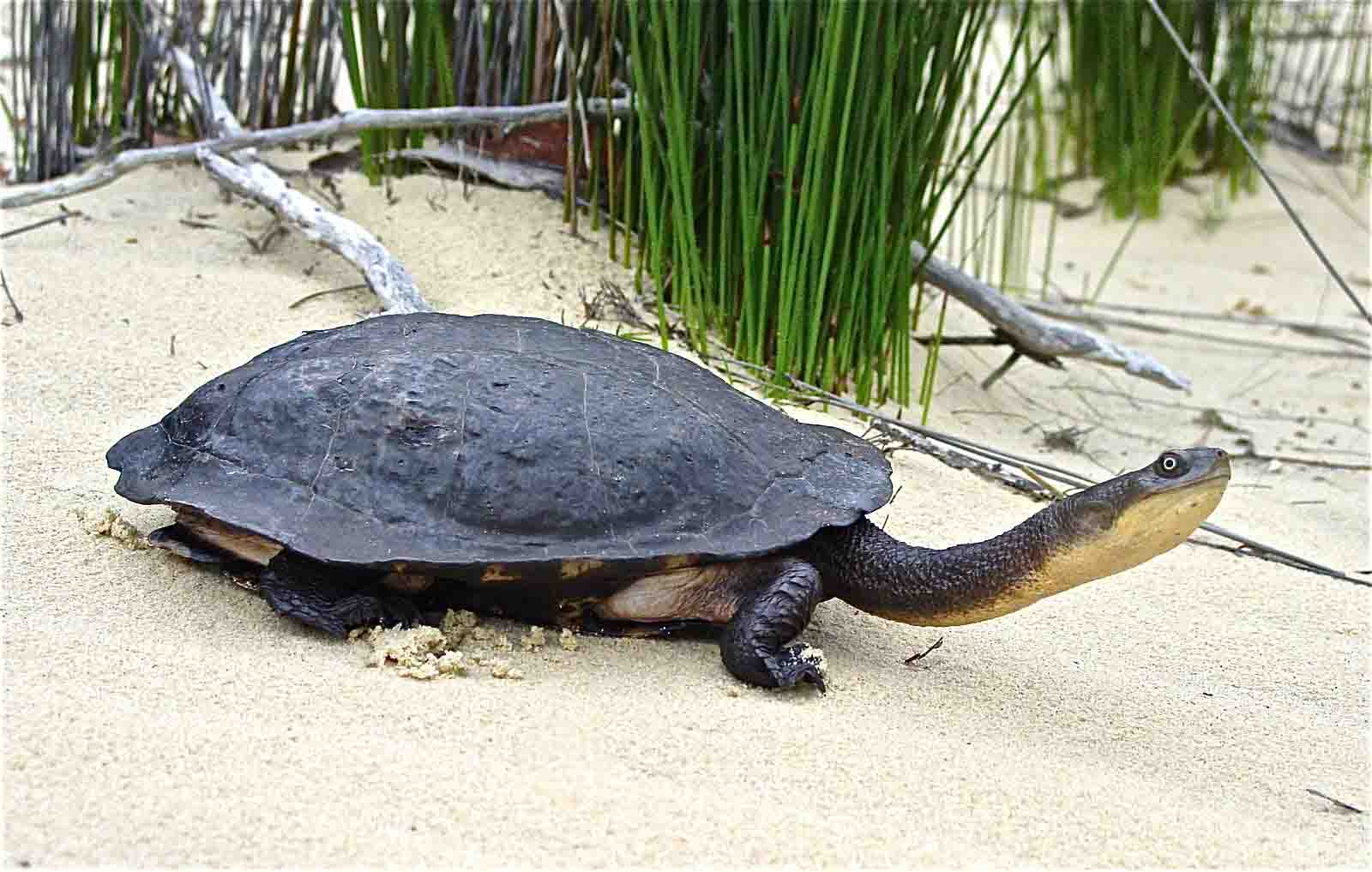
The eastern long-necked turtle, Chelodina longicollis (Family Chelidae), has a wide distribution throughout southeastern Australia. It occupies a broad range of freshwater aquatic habitats but is more abundant in shallow, ephemeral wetlands often remote from permanent rivers. Its propensity for long distance overland migration, coupled with a low rate of desiccation and the capacity to estivate on land, enable it to exploit highly-productive ephemeral habitats in the absence of competition from fish and other turtle species. In wetter periods, such habitats provide optimal conditions for growth and reproduction. In drier periods, however, turtles may need to seek refuge in permanent water where high population densities and low productivity can lead to reduced growth rates and reproductive output. The species is an opportunistic carnivore that feeds on a broad range of plankton, nekton and benthic macro-invertebrates, carrion, as well as terrestrial organisms that fall upon the water. It is relatively slow to mature (7–8 yrs for males and 10–12 yrs for females), lays between 6 and 23 hard-shelled eggs during spring and late summer, and can produce up to 3 clutches per year. Although currently considered common and not under major threat, the most widespread conservation concern for C. longicollis is high nest predation from the introduced fox (Vulpes vulpes), and roads, pest fencing, and habitat changes brought about by prolonged drought and climate change, which present localized and potential future threats for certain populations.
Distribution
Australia. Found throughout southeastern Australia, including southeastern Queensland, New South Wales, Victoria, and southeastern South Australia.
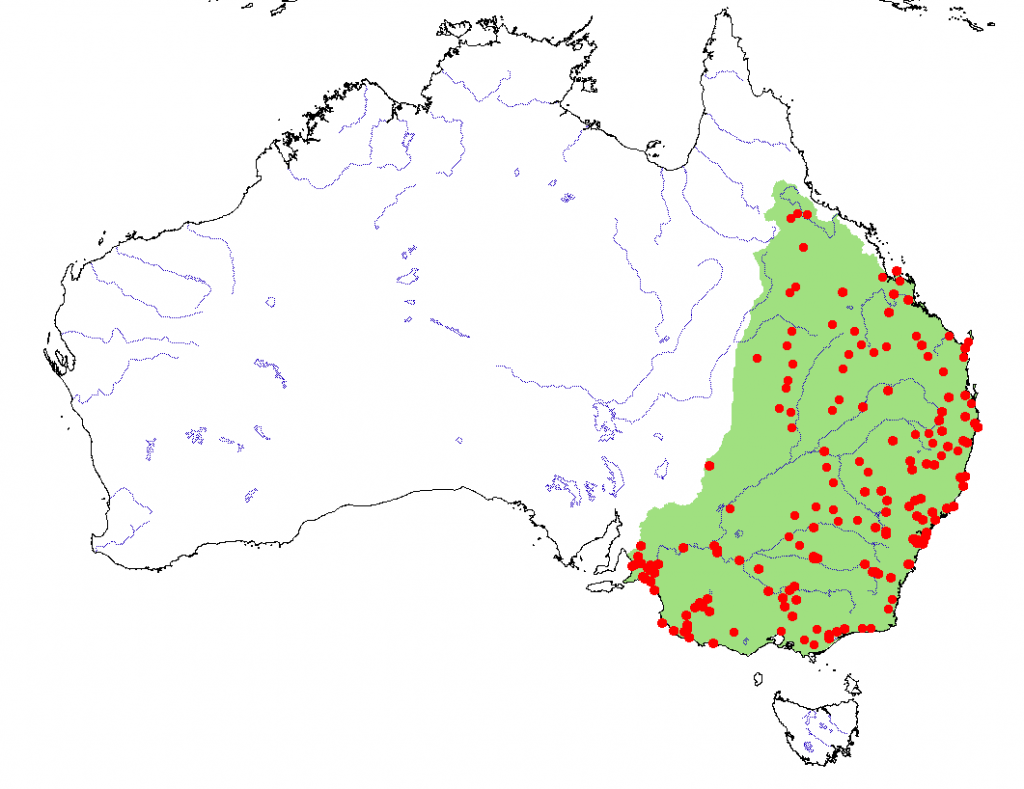
Distribution of Chelodina longicollis in Australia. Red points = museum and literature occurrence records based on Iverson (1992) plus more recent and authors' data; green shading = projected distribution based on GIS-defined hydrologic unit compartments (HUCs) constructed around verified localities and then adding HUCs that connect known point localities in the same watershed or physiographic region, and similar habitats and elevations as verified HUCs (Buhlmann et al., in press), and adjusted based on authors' data. Populations on Bass Strait islands north of Tasmania are considered introduced and are not shown here.
Synonymy
Testudo longicollis Shaw 1794, Emys longicollis, Chelodina longicollis, Hydraspis longicollis, Chelys (Chelodina) longicollis, Chelydura longicollis, Chelodina longicollis longicollis, Chelodina novaehollandiae Duméril and Bibron 1835, Chelodina sulcata Gray 1856a, Chelodina longicollis sulcata, Chelodina sulcifera Gray 1856b, Chelodina longicollis sulcifera.
Subspecies
None currently recognized.
Conservation Status
IUCN 2008 Red List: Not Listed (= Least Concern, LR/lc) (assessed 1996, needs updating)
Legal Status
CITES: Not Listed; Australian EPBC Act: Not Listed.
Citation
Kennett, R., Roe, J., Hodges, K., and Georges, A. 2009. Chelodina longicollis (Shaw 1784) – eastern long-necked turtle, common long-necked turtle, common snake-necked turtle. In: Rhodin, A.G.J., Pritchard, P.C.H., van Dijk, P.P., Saumure, R.A., Buhlmann, K.A., Iverson, J.B., and Mittermeier, R.A. (Eds.). Conservation Biology of Freshwater Turtles and Tortoises: A Compilation Project of the IUCN/SSC Tortoise and Freshwater Turtle Specialist Group. Chelonian Research Monographs No. 5, pp. 031.1-031.8, doi:10.3854/crm.5.031.longicollis.v1.2009, //iucn-tftsg.org/cbftt/.