
Summary
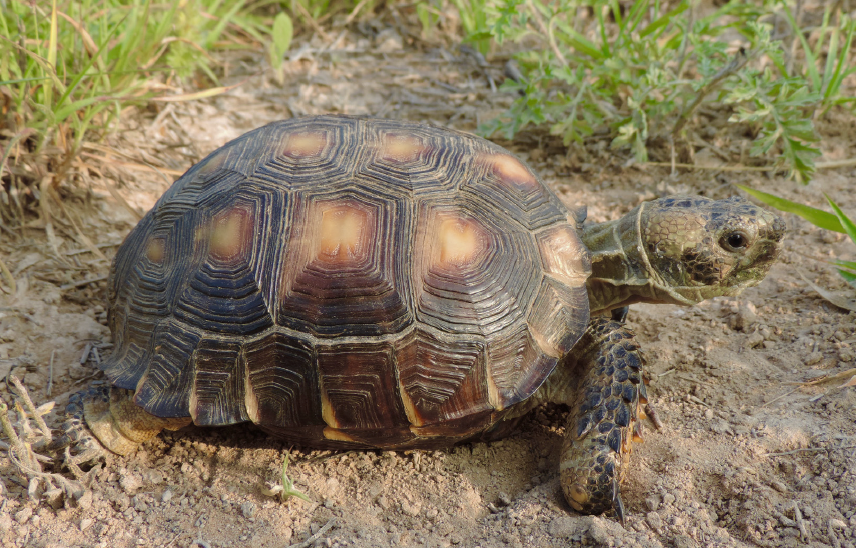
The Texas Tortoise, Gopherus berlandieri (family Testudinidae), is a small, terrestrial tortoise native to southern Texas in the United States and northeastern Mexico. It is the smallest living member of its genus, with adults beginning to display secondary sexual characteristics at around 13 cm in shell length and typically growing no larger than 24 cm in maximum shell length. The species has a moderately domed, rounded shell that is usually brown to tan in adults, whereas juveniles are darker with yellow centers on each scute. Males and females are readily distinguished by various secondary sexual characteristics – males possess a more concave plastron, longer tails, and a longer gular projection than females. The species lays up to three clutches per year, each consisting of 1–5 elongate eggs that average approximately 4.2 cm in length and 3.4 cm in width, with eggs often distributed among multiple nests. This tortoise inhabits subtropical dry shrublands, particularly thornscrub (chaparral) ecosystems, and is also found on elevated coastal hills (lomas) and remnant riparian habitats. It is herbivorous and consumes a variety of grasses, forbs, and prickly pear cactus. The species is diurnal and has an annual activity period from approximately April to November. It is less active during the extreme heat of summer and enters a period of relative inactivity during colder months. Gopherus berlandieri has federal-level protection in Mexico and state-level protection in Texas in the United States. Nevertheless, threats to this species such as habitat loss, habitat fragmentation, and road mortality impact its populations. The effects of disease and invasive species on this tortoise are not well understood and deserve more attention. Much more is known about the status of populations in the United States as compared to Mexico. Efforts to better monitor this species in both Mexico and the United States are necessary to provide a more complete assessment of its status.
Distribution
Mexico, USA. Occurs across southern Texas in the USA and across much of Tamaulipas and Nuevo Leon, eastern Coahuila, northern Veracruz, and eastern San Luis Potosi in Mexico.
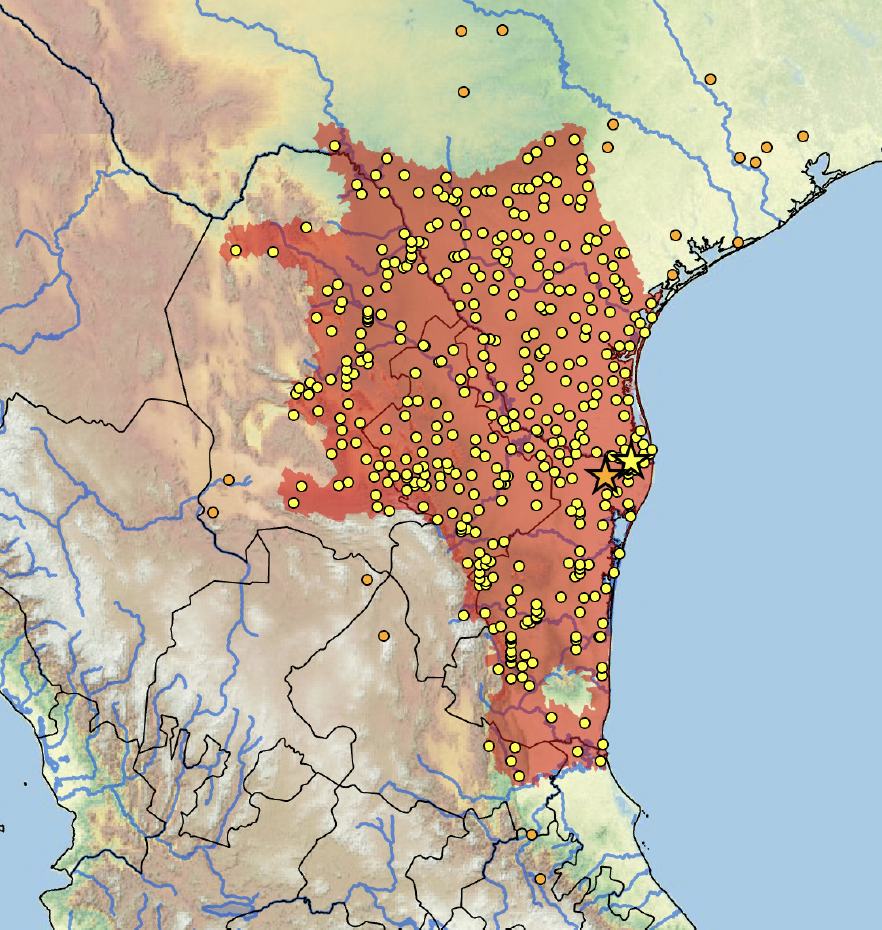
Estimated historical indigenous distribution of Gopherus berlandieri in Texas, USA, and Mexico. Yellow dots = museum and current and historical occurrence records of presumed native populations based on literature and online records (TTWG 2025; in prep.); orange dots = presumed translocated or introduced non-native records; yellow star = restricted type locality for Xerobates berlandieri Agassiz 1857; orange star = estimated type locality for Testudo tuberculata Berlandier 1850 and Testudo bicolor Berlandier 1850 (nomina oblita). Colored shading = estimated historical indigenous range. Distribution is based on fine-scaled GIS-defined level 12 HUCs (hydrologic unit compartments) constructed around localities and then adding HUCs that connect point localities in the same watershed or physiographic region, and similar habitats and elevations as verified HUCs, based on TTWG (2025) and adjusted based on subsequent data (TTWG, in prep.) and from the authors. Map by Chelonian Research Foundation.
Synonymy
Testudo tuberculata Berlandier 1850 (junior homonym and nomen oblitum; not Testudo tuberculata Pennant in Schoepff 1801); Testudo bicolor Berlandier 1850 (nomen oblitum); Xerobates berlandieri Agassiz 1857; Testudo berlandieri; Xerobates gopher berlandieri; Gopherus berlandieri; Gopherus polyphemus berlandieri; Scaptochelys berlandieri; Testudo minima Berlandier in Bour 2017 (nomen nudum).
Subspecies
None recognized.
Conservation Status
Last Updated on: 14 October 2026
Legal Status
Last Updated on: 14 October 2026
Citation
Mali, I., Couvillon, R.O., and Forstner, M.R.J. 2026. Gopherus berlandieri (Agassiz 1857) – Texas Tortoise, Berlandier’s Tortoise, Galapago Tamaulipas. In: Rhodin, A.G.J., Iverson, J.B., van Dijk, P.P., Stanford, C.B., Goode, E.V., Buhlmann, K.A., and Mittermeier, R.A. (Eds.). Conservation Biology of Freshwater Turtles and Tortoises: A Compilation Project of the IUCN/SSC Tortoise and Freshwater Turtle Specialist Group. Chelonian Research Monographs 5(20):142.1–17. doi: 10.3854/crm.5.142.berlandieri.v1.2026; www.iucn-tftsg.org/cbftt/.