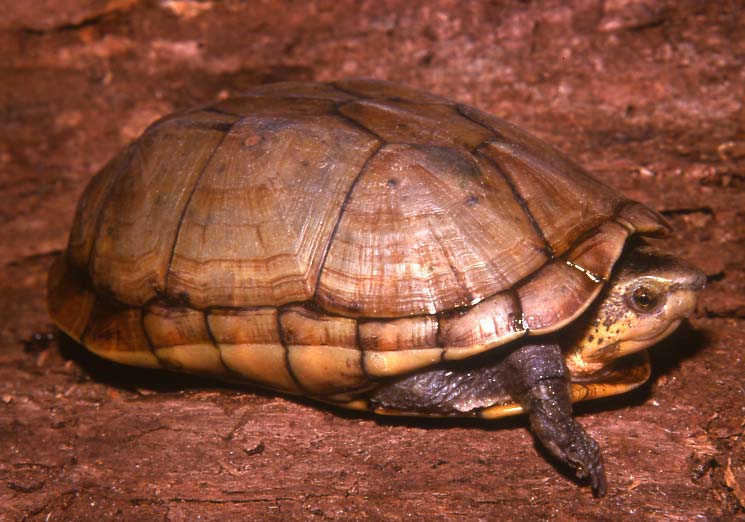
Adult female Kinosternon scorpioides scorpioides from Cojedes, Venezuela.
Photo by John Iverson.
Summary
Kinosternon scorpioides, the Scorpion Mud Turtle (Family Kinosternidae), is a medium to large-sized mud turtle, with adult males in some populations regularly exceeding 200 mm in carapace length. The species occurs from the Mexican state of Tamaulipas in Gulf of Mexico drainages, southward throughout the Isthmus of Tehuantepec and the Yucatan Peninsula in Mexico, and throughout most of Central and South America in both Atlantic and Pacific drainages at least to the upper Río Paraná in northern Argentina. Four subspecies are currently recognized, which vary in morphology: K. s. scorpioides, K. s. abaxillare, K. s. albogulare, and K. s. cruentatum. Maximum size in various populations ranges from 150 to over 200 mm carapace length. Mature females lay up to five clutches of 1–8 eggs during an extended annual reproductive season. The species is exploited in parts of its range for tourist trinkets, pet trade, medicine, and food, but the greatest threats to its survival are from habitat degradation and alteration. Conservation measures should include expanded studies of the status of the species throughout its range, as well as detailed studies of its life history, habitat utilization, diseases, and the effects of habitat modification on individuals and populations across its range.
Distribution
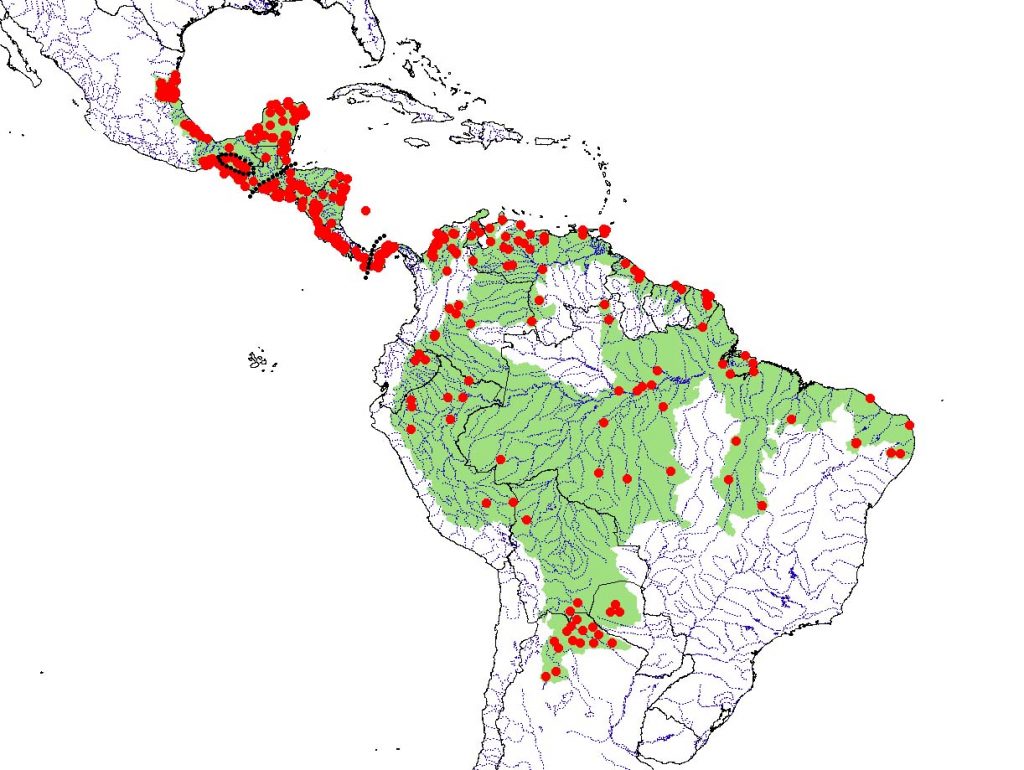
Argentina, Belize, Bolivia, Brazil, Colombia, Costa Rica, Ecuador, El Salvador, French Guiana, Guatemala, Guyana, Honduras, Mexico, Nicaragua, Panama, Paraguay, Peru, Suriname, Trinidad, Venezuela. Northeast and eastern Mexico through Central America and across northern and central South America to northern Argentina.
Distribution of Kinosternon scorpioides in Central and South America; dotted lines delimit the distribution of subspecies: K. s. cruentatum from Mexico to Guatemala, K. s. abaxillare as an enclave in central Chiapas, Mexico, K. s. albogulare from Honduras and El Salvador to Panama, and K. s. scorpioides from Panama to Argentina. Red dots = museum and literature occurrence records of native populations based on Iverson (1992), plus more recent and authors' data; green shading = projected native distribution based on GIS-defined hydrologic unit compartments (HUCs) constructed around verified localities and then adding HUCs that connect known point localities in the same watershed or physiographic region, and similar habitats and elevations as verified HUCs (Buhlmann et al. 2009), and adjusted based on authors' data.