Summary
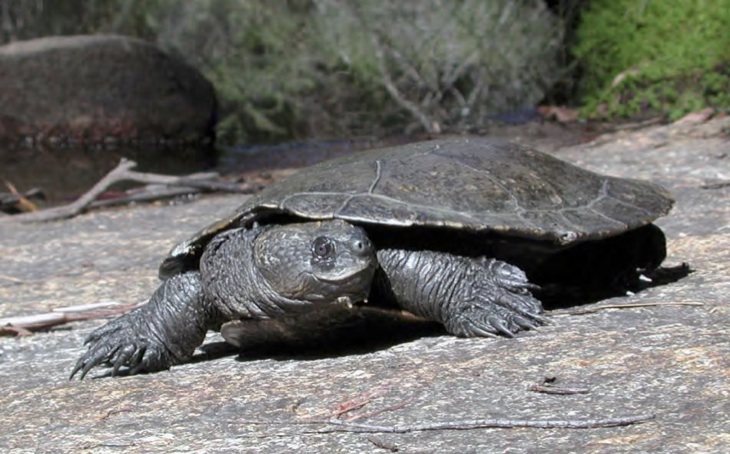
Myuchelys bellii is an intermediate-sized short-necked freshwater turtle (Family Chelidae) with a range restricted to upland streams in the Namoi, Gwydir, and Border Rivers catchments of the Murray-Darling Basin, New South Wales and Queensland, Australia. Sexual size dimorphism is moderate, with adult males (up to 227 mm carapace length) smaller than females (up to 300 mm). The species occupies streams between 600 and 1100 m elevation that contain permanent pools deeper than about 2 m, frequently with granite boulders and bedrock, and often with underwater caverns formed by boulders, logs, and overhanging banks. In areas of lower water velocity, the typical substratum is coarse granitic sand overlain by fine silt, algal growth, and dense beds of macrophytes. The species has a nonspecialized omnivorous diet, which includes aquatic plants, algae, sponges, terrestrial fruits, aquatic insects, crayfish, and carrion. The species lays a single clutch of between 8 and 23 eggs per year in September–December and has one of the lowest reproductive outputs of any Australian chelid. Eggs hatch after 49–51 days, and hatchlings average 26.7 mm in carapace length. The species relies on aquatic respiration through cloacal bursae during inactive winter months to hibernate at depth, and has a crepuscular habit during the active months, using shallows and riffle zones for foraging at night. Threats include ongoing loss of riparian vegetation, loss of lotic habitat from water resource development and associated infrastructure, and physical modifications resulting from land clearing and livestock grazing, such as increased turbidity and infilling of deep pools. There is concern also for the impact of exotic nest predators, exotic fish, translocation of other native turtle species, and disease. No major conservation initiatives are currently directed at the species, but are planned under the draft recovery strategy of the NSW Office of Environment and Heritage. It is regarded as potentially vulnerable to extinction.
Distribution
Australia. Restricted to upland streams of the Namoi, Gwydir, and Border Rivers catchments of the inland Murray-Darling Basin in northeastern New South Wales and extreme southeastern Queensland.
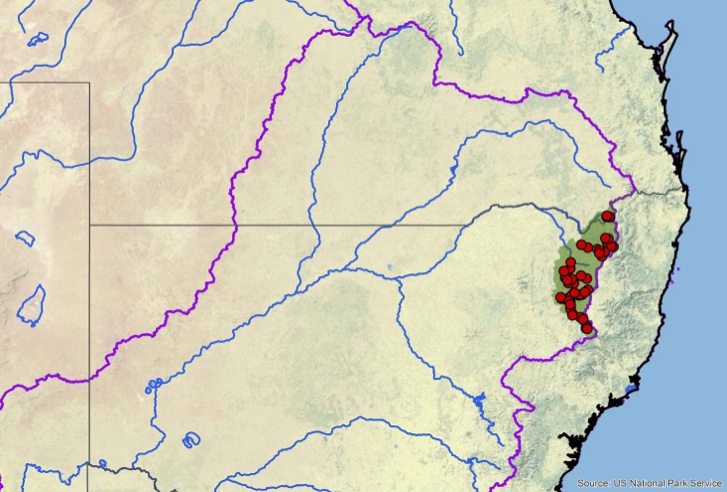
Distribution of Myuchelys bellii in eastern Australia. Purple lines = boundaries delimiting major watersheds (level 3 hydrologic unit compartments – HUCs); red dots = museum and literature occurrence records based on Cann (1998) plus more recent data, and the authors' personal data; green shading = projected historic native distribution based on GIS-defined level 10 HUCs constructed around verified localities and then adding HUCs that connect known point localities in the same watershed or physiographic region, and similar habitats and elevations as verified HUCs (Buhlmann et al. 2009; TTWG 2014), and adjusted based on authors' subsequent data.
Synonymy
Phrynops bellii Gray 1844, Hydraspis bellii, Elseya bellii, Wollumbinia bellii1, Wollumbinia bellii bellii1, Elseya latisternum bellii, Myuchelys bellii, Elseya dorriani Wells 20021 (nomen nudum).
Subspecies
None currently recognized.
Conservation Status
IUCN 2015 Red List: Endangered B1+2c (as Elseya bellii, assessed 1996), TFTSG Draft Red List: Endangered (EN, assessed 2011)
Legal Status
CITES: Not Listed; Environment Protection and Biodiversity Conservation Act 1999: Vulnerable; New South Wales National Parks and Wildlife Act 1979: Vulnerable; Queensland Nature Conservation Act 1992: Least Concern.
Citation
Fielder, D., Chessman, B., and Georges, A. 2015. Myuchelys bellii (Gray 1844) – Western Saw-shelled Turtle, Bell's Turtle. In: Rhodin, A.G.J., Pritchard, P.C.H., van Dijk, P.P., Saumure, R.A., Buhlmann, K.A., Iverson, J.B., and Mittermeier, R.A. (Eds.). Conservation Biology of Freshwater Turtles and Tortoises: A Compilation Project of the IUCN/SSC Tortoise and Freshwater Turtle Specialist Group. Chelonian Research Monographs 5(8):088.1–7, doi:10.3854/crm.5.088.bellii.v1.2015, //iucn-tftsg.org/cbftt/.