
Summary
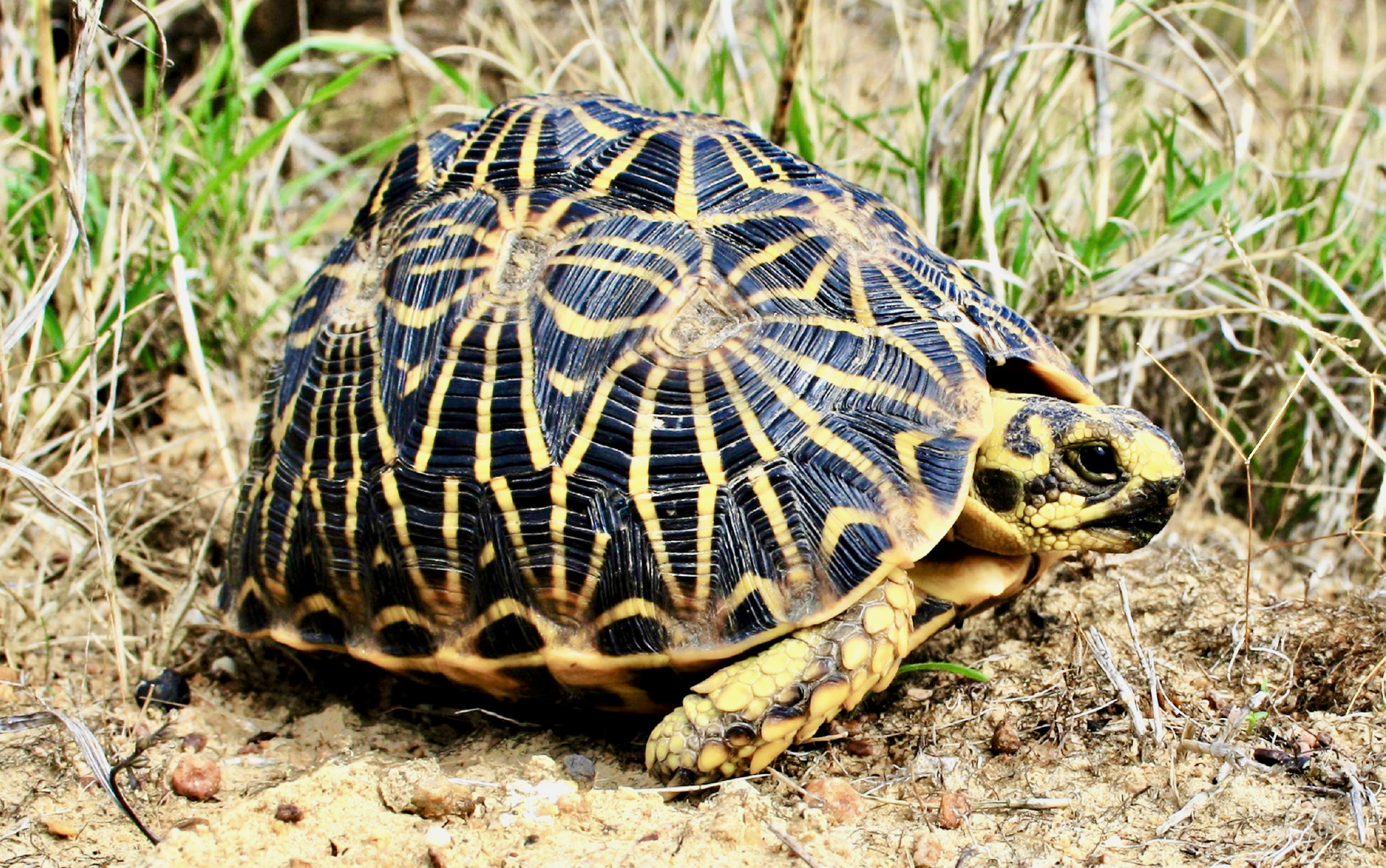
The Geometric Tortoise, Psammobates geometricus (family Testudinidae), is a small tortoise from southwestern South Africa (female straight-line carapace length [SCL] up to 16.5 cm, male SCL up to 12.3 cm; adult females average 1.2 times longer and twice as heavy as males). It is one of three recognized “starred” tortoises of the genus Psammobates of the southern African sub-continent and has the smallest distribution among them. It is endemic to landscapes in the Western Cape Province of South Africa, where small, highly fragmented and isolated populations are exposed to numerous threats, including habitat loss, fragmentation, degradation, and destruction. Geometric Tortoises are restricted to the “renosterveld” ecoregion of the Fynbos Biome of South Africa. Hatchlings and juveniles grow rapidly until ca. 8–9 cm SCL, whereafter growth slows considerably. Males reach sexual maturity at ca. 8–10 years and females at ca. 11–13 years. Home range size varies considerably depending on season and sex, and fragmented, suitable habitat patches, with small, non-viable populations, are often smaller than the home range size of one tortoise. Females produce 1–5 eggs per clutch and may lay more than one clutch per year. Body condition and hematology are influenced by environmental conditions. Food plants are selected based on nutritional value (e.g., soluble carbohydrates and phosphorus) and low biomechanical costs (tensile strength). The Geometric Tortoise is on the brink of extinction and is one of the most critically endangered tortoise species in the world. The survival of P. geometricus in the wild is threatened by habitat destruction for dryland and deciduous fruit agriculture, viticulture, avian and mammalian predation (corvids, baboons and honey badgers), invasive alien woody and herbaceous plants, overgrazing and trampling by domestic stock, droughts and wildfires. The species is fully protected by regional (Western Cape Province) and national (South Africa) biodiversity legislation, as well as listed by international conventions (IUCN Red List and CITES); however, small, isolated populations remain highly vulnerable to poaching and extermination by stochastic events. Conservation measures include effective land management, threat mitigation, enhancement of reproductive output, adult female and first-year survival, and securing more land under formal protection. Declaring biodiversity stewardship contract reserves is needed to maintain existing populations and viable habitat on private land and in a network of protected areas. A completed Species Conservation Plan (final draft under review) will coalesce interested and affected parties in securing a future for the species.
Distribution
South Africa. Restricted to the “renosterveld” ecoregion of the Fynbos Biome of Western Cape Province, South Africa.
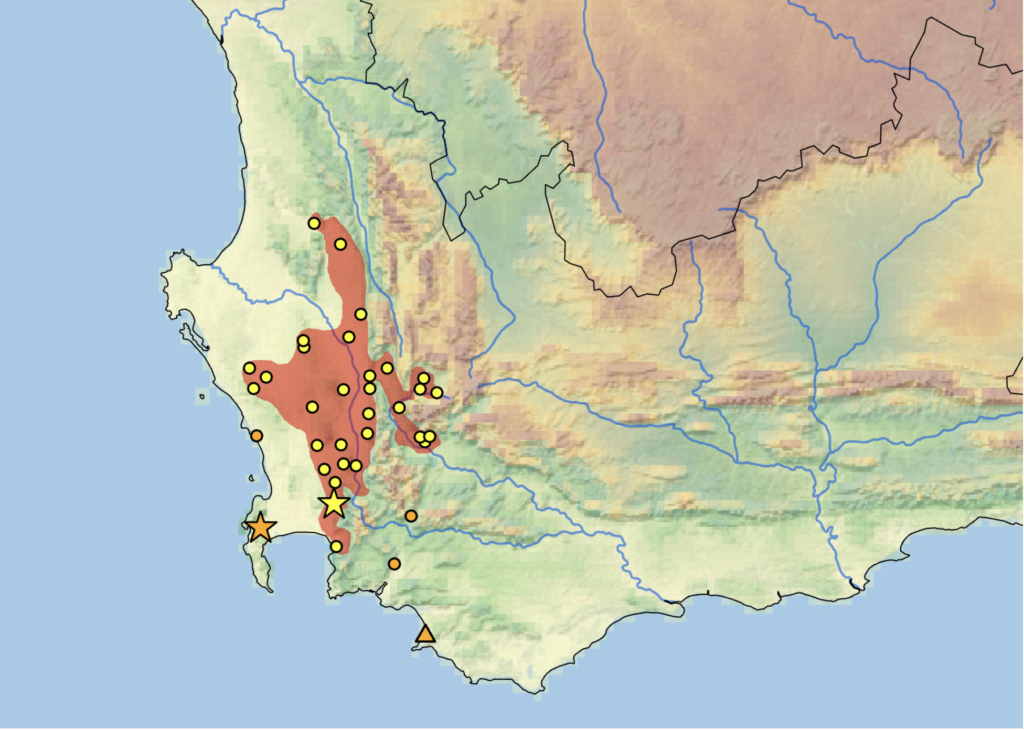
Estimated historical indigenous distribution of Psammobates geometricus in South Africa. Yellow dots = museum and current and historical occurrence records of presumed native populations based on literature and online records (TTWG 2025, in prep.); orange dots = possible relictual or other questionable records; orange triangle = archeological site; yellow star = restricted estimated type locality for Testudo geometrica Linnaeus 1758; orange star = type locality for Testudo strauchi Lidth de Jeude 1893 (probable trade specimen). Colored shading = estimated historical indigenous range. Distribution is based on fine-scaled GIS-defined level 12 HUCs (hydrologic unit compartments) constructed around native localities and then adding HUCs that connect point localities in the same watershed or physiographic region, and similar habitats and elevations as verified HUCs, based on TTWG (2025, in prep.) and then converted to an elevation-limited polygon and adjusted based on further data from the authors. Map by Chelonian Research Foundation.
Synonymy
Testudo geometrica Linnaeus 1758, Chersine geometrica, Hydrone geometrica, Psammobates geometricus, Peltastes geometricus, Peltastes geometrica, Peltastes (Chersinella) geometrica, Chersinella geometrica, Psammobates geometrica, Geochelone geometrica, Testudo luteola Daudin 1801, Peltastes geographicus Gray 1869 (nomen novum), Testudo geographica, Testudo strauchi Lidth de Jeude 1893, Chersinella strauchi.
Subspecies
None recognized.
Conservation Status
Last Updated on: 29 October 2026
Legal Status
Last Updated on: 29 October 2026
Citation
Baard, E.H.W., Hofmeyr, M.D., Henen, B.T., and Juvik, J.O. 2026. Psammobates geometricus (Linnaeus 1758) – Geometric Tortoise, Geometriese Skilpad, Suurpootjie. In: Rhodin, A.G.J., Iverson, J.B., van Dijk, P.P., Stanford, C.B., Goode, E.V., Buhlmann, K.A., and Mittermeier, R.A. (Eds.). Conservation Biology of Freshwater Turtles and Tortoises: A Compilation Project of the IUCN/SSC Tortoise and Freshwater Turtle Specialist Group. Chelonian Research Monographs 5(20):145.1–26. http://dx.doi.org/10.3854/crm.5.145.geometricus.v1.2026.