
Summary
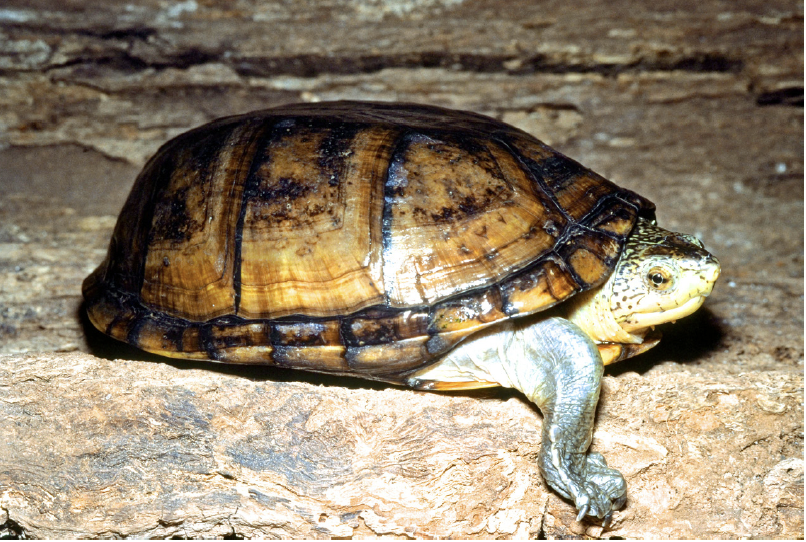
The Mexican Mud Turtle, Kinosternon integrum (family Kinosternidae), is a very wide-ranging freshwater turtle distributed from northwestern Mexico (Sonora) southward along the Pacific coast and across the Mexican Plateau nearly to the Isthmus of Tehuantepec. Kinosternon integrum is one of the largest species in the genus, with the larger males typically reaching 210 mm of maximum straight-line carapace length (SCL), and the smaller females reaching 190 mm SCL; there are extraordinary records for males of 220 and 223 mm SCL and 810 g in body mass. It is apparently parapatric with its close relatives K. cruentatum, K. mexicanum, K. chimalhuaca, and K. oaxacae, but occurs in broad sympatry with other related species (K. alamosae and K. hirtipes). Although it has extensive geographic variation, no subspecies are currently recognized. It is omnivorous and inhabits nearly every aquatic habitat within its range, but also regularly estivates terrestrially. Population densities are among the highest known for turtles. Females nest from at least May through October, producing multiple clutches of 3–11 eggs each. Eggs exhibit embryonic diapause and require chilling for development to commence; thus, hatching occurs during the rainy season the year following nesting. The species is incredibly abundant in many areas, despite the fact that it is sold in markets for human consumption and that human manipulation of water resources may threaten some populations.
Distribution
Mexico. Occurs from northwestern Mexico (southern Sonora) and northeastern Mexico (southwestern Tamaulipas) to the Mexican Transvolcanic Belt, the upper Papalopapan basin in Puebla, and the Sierra Norte of Oaxaca. Along the coast of the Pacific, the distribution extends from southern Sonora through Sinaloa, Nayarit, and Jalisco, parapatric to the range of Kinosternon chimalhuaca in Jalisco and Colima, and continuing along the coasts of Colima, Michoacán, and Guerrero, where it abuts the distribution of K. oaxacae. Kinosternon integrum is the freshwater turtle with the largest distribution in Mexico.
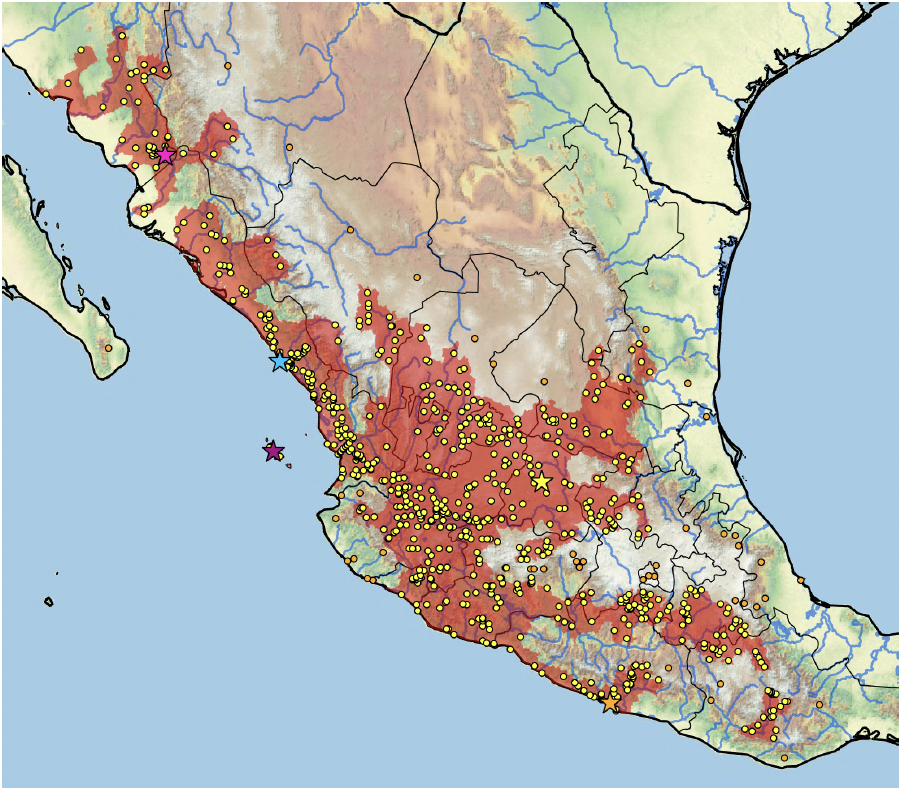
Estimated historical indigenous distribution of Kinosternon integrum in Mexico. Yellow dots = museum and current and historical occurrence records of presumed native populations based on literature and online records (TTWG 2025; in prep.); orange dots = presumed translocated or introduced non-native records; yellow star = type locality for Cinosternon rostellum Bocourt 1876 and emended restricted type locality for Kinosternum integrum Le Conte 1854; orange star = original restricted type locality for Kinosternum integrum Le Conte 1854; blue star = restricted type locality for Cinosternum scorpioides integrum mexicana Siebenrock 1907; pink star = type locality for Kinosternon iversoni Joseph-Ouni et al. 2025b; purple star = type locality for Kinosternon mariamadre Joseph-Ouni et al. 2025c. Colored shading = estimated historical indigenous range. Distribution is based on fine-scaled GIS-defined level 12 HUCs (hydrologic unit compartments) constructed around localities and then adding HUCs that connect point localities in the same watershed or physiographic region, and similar habitats and elevations as verified HUCs, based on TTWG (2025) and adjusted based on subsequent data (TTWG, in prep.) and from the authors. Map by Chelonian Research Foundation.
Synonymy
Kinosternum integrum Le Conte 1854, Cinosternum integrum, Thyrosternum integrum, Thyrosternon integrum, Cinosternon integrum, Kinosternon integrum, Swanka integra, Cinosternon integrum, Cinosternum scorpioides integrum, Cinosternon rostellum Bocourt 1876, Cinosternon guanajuatense Dugès 1888 (nomen nudum), Cinosternum scorpioides integrum mexicana Siebenrock 1907 (unavailable name), Kinosternon iversoni Joseph-Ouni, Vander Schouw, McCord, Frewer, and Uhrig 2025b, Kinosternon mariamadre Joseph-Ouni, Vander Schouw, Frewer, Uhrig, and McCord 2025c.
Subspecies
No subspecies are currently recognized.
Conservation Status
Last Updated on: 18 October 2026
Legal Status
Last Updated on: 18 October 2026
Citation
Iverson, J.B. and Macip-Ríos, R. 2026. Kinosternon integrum (Le Conte 1854) – Mexican Mud Turtle, Casquito de Fango Mexicana, Casquito de Burro. In: Rhodin, A.G.J., Iverson, J.B., van Dijk, P.P., Stanford, C.B., Goode, E.V., Buhlmann, K.A., and Mittermeier, R.A. (Eds.). Conservation Biology of Freshwater Turtles and Tortoises: A Compilation Project of the IUCN/SSC Tortoise and Freshwater Turtle Specialist Group. Chelonian Research Monographs 5(20):143.1–15. doi: 10.3854/crm.5.143.integrum.v1.2026; www.iucn-tftsg.org/cbftt/.