
Summary
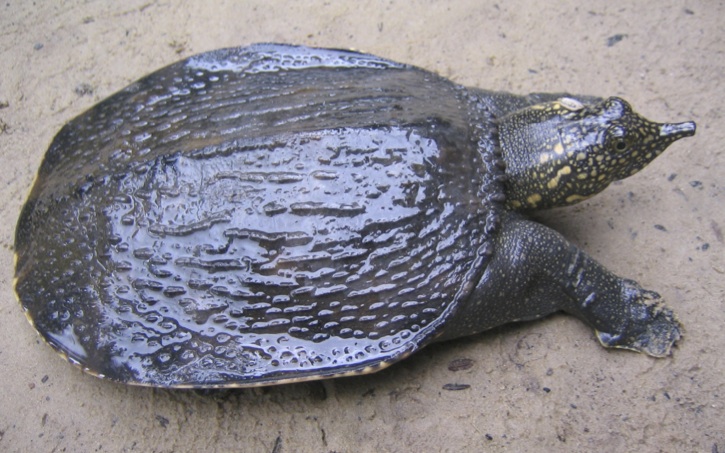
The Asiatic Softshell Turtle, Amyda cartilaginea (Family Trionychidae), is a large species (total carapace length up to 850 mm) showing considerable variation in coloration over its wide range in tropical Southeast Asia. A recent genetic analysis suggests A. cartilaginea may be a species complex consisting of three species level clades with several subspecies. The turtle inhabits most types of aquatic habitats, from hill streams to rivers and swamps. It is an opportunistic omnivore with a preference for animal food. No comprehensive study of its reproductive biology exists; published observations suggest that females lay multiple clutches throughout the year with most nests being laid in the dry season, with clutch size ranging 3–28 eggs. Incubation period depends on microhabitat conditions and may last from 2–4.5 months. Amyda cartilaginea is a popular food animal; it is intensively exploited and appears frequently in the Asian food trade. Although some populations are in decline, the species still appears moderately abundant, at least at some sites. Several populations occur in protected areas. Specific conservation actions for heavily exploited populations appear to be overdue. Continued unregulated and unreported international trade would undoubtedly further threaten the species and careful monitoring of this trade is necessary.
Distribution
Bangladesh, Brunei Darussalam, Cambodia, India, Indonesia, Laos, Malaysia, Myanmar, Singapore, Thailand, Vietnam. Broadly distributed in Southeast Asia from extreme eastern Bangladesh and India through Indochina to Borneo and the large continental islands of Indonesia. Records from Yunnan, China, and east of Wallace’s line (e.g., Lombok, Sulawesi) very likely represent introduced individuals.
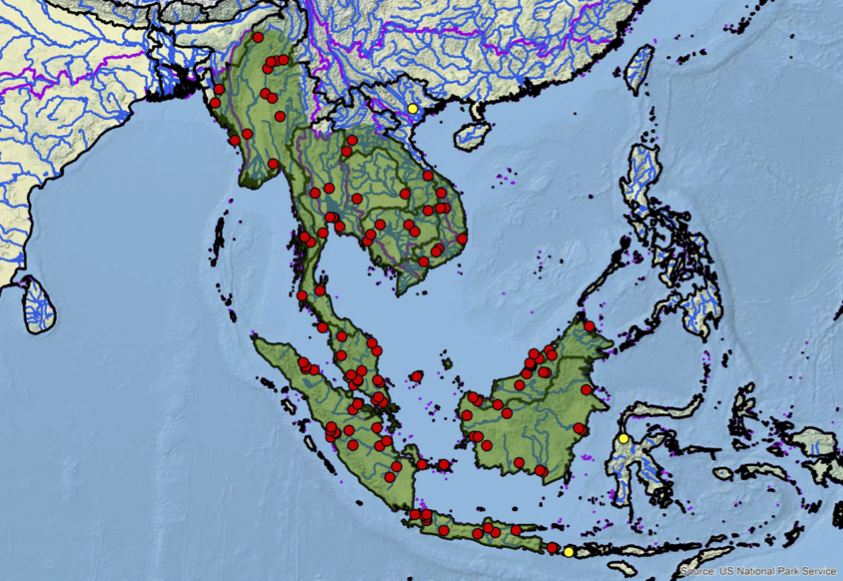
Distribution of Amyda cartilaginea in Southeast Asia. Purple lines = boundaries delimiting major watersheds (level 3 hydrologic unit compartments – HUCs); red dots = museum and literature occurrence records based on Iverson (1992) plus more recent data, and the authors' personal data; yellow dots = presumed introduced specimens; green shading = projected historic native distribution based on GIS-defined level 8 HUCs constructed around verified localities and then adding HUCs that connect known point localities in the same watershed or physiographic region, and similar habitats and elevations as verified HUCs (Buhlmann et al. 2009; TTWG 2014), and adjusted based on authors' subsequent data.
Synonymy
Testudo cartilaginea Boddaert 1770a, Gymnopus cartilaginea, Trionyx cartilagineus, Aspidonectes cartilagineus, Potamochelys cartilagineus, Amyda cartilaginea, Amyda cartilaginea cartilaginea, Testudo membranacea Blumenbach 1779 (nomen dubium), Testudo boddaerti Schneider 1787 (nomen novum), Trionyx boddaerti, Testudo striata Suckow 1798 (partim, nomen novum), Amyda javanica Schweigger in Geoffroy Saint-Hilaire 1809, Trionyx javanicus, Tyrse javanica, Aspidonectes javanicus, Trionyx stellatus javanica, Aspilus javanicus, Potamochelys javanicus, Trionyx stellatus Geoffroy Saint-Hilaire 1809 (nomen novum), Potamochelys stellatus, Trionyx cariniferus Gray 1856, Aspilus cariniferus, Trionyx carinifera, Trionyx ornatus Gray 1861, Aspilus ornatus, Ida ornata, Amyda ornata, Amyda ornata ornata, Aspilus punctulatus Gray 1864, Trionyx phayrei Theobald 1868, Aspidonectes phayrei, Trionyx jeudi Gray 1869, Trionyx ephippium Theobald 1875, Trionyx phayrii Boulenger 1889 (nomen novum), Amyda phayrii, Trionyx trinilensis † Jaekel 1911 [Pleistocene], Trionyx nakornsrithammarajensis Nutaphand 1979, Amyda nakornsrithammarajensis, Trionyx cartilageneus nakorn Nutaphand 1990 (nomen novum), Trionyx cartilagineus nakorn, Amyda cartilaginea maculosa Fritz, Gemel, Kehlmaier, Vamberger, and Praschag 2014.
Subspecies
None currently recognized here, but see alternative taxonomy below.
Conservation Status
IUCN 2015 Red List: Vulnerable (VU A1cd+2cd, assessed 2000); TFTSG Draft Red List: Vulnerable (VU, assessed 2011)
Legal Status
CITES: Appendix II.
Citation
Auliya, M., van Dijk, P.P., Moll, E.O., and Meylan, P.A. 2016. Amyda cartilaginea (Boddaert 1770) – Asiatic Softshell Turtle, Southeast Asian Softshell Turtle. In: Rhodin, A.G.J., Pritchard, P.C.H., van Dijk, P.P., Saumure, R.A., Buhlmann, K.A., Iverson, J.B., and Mittermeier, R.A. (Eds.). Conservation Biology of Freshwater Turtles and Tortoises: A Compilation Project of the IUCN/SSC Tortoise and Freshwater Turtle Specialist Group. Chelonian Research Monographs 5(9):092.1–17, doi:10.3854/crm.5.092.cartilaginea.v1.2016, //iucn-tftsg.org/cbftt/.