
Summary
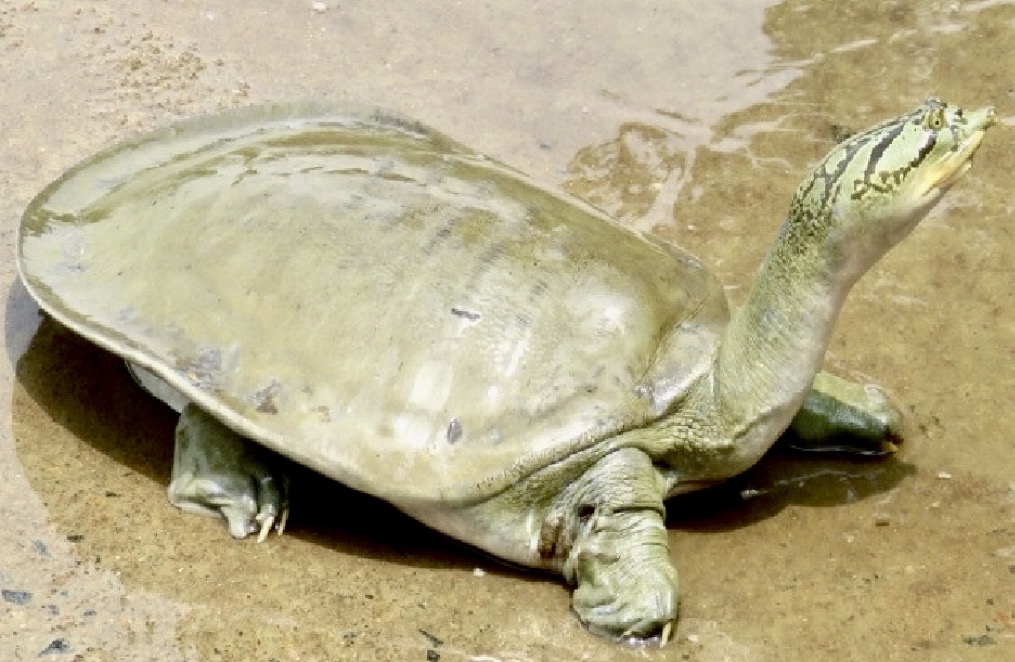
The Indian (or Ganges) Softshell Turtle, Nilssonia gangetica (family Trionychidae), is a monotypic species that occurs in northern India and neighboring countries of South Asia. Females are usually larger than males, with average female size ca. 70 cm straight-line carapace length (SCL) (maximum size up to 94.0 cm SCL) and average male size is only ca. 28 cm SCL, but can reach up to 77.0 cm SCL. The species is primarily carnivorous. The ecology of N. gangetica has been relatively well studied in the National Chambal Sanctuary in northern India. The species basks on sand banks, riverside rocks, and mid-riverine islands. Nesting occurs during the fall and early winter (August–October). The average clutch size is 13.7 eggs (range 6–39) and the species apparently lays one to two or more clutches per season. The eggs are spherical in shape, with a mean diameter of 29.5 mm. The eggs hatch after an average incubation period of 250–275 days, following a period of diapause. Major rehabilitation programs for conservation of the species are present in the Ganges (Ganga) River basin; wild-laid eggs were collected from the Chambal River and incubated in captive facilities and juveniles were released near Varanasi in the Ganges River. Research studies on distribution, behavior, habitat use, genetics, reproduction, exploitation, and conservation of N. gangetica have been carried out rangewide. The species was formerly common in several northern Indian rivers, but its populations are declining in many of its habitats. There has been a large illegal trade of live animals in north and northeast India, and the species is heavily exploited for commercial use. Nationwide surveys have indicated that fairly good populations are present in many protected areas. The species receives protection under respective National legislation in different countries and international listings through the IUCN Red List as Endangered and CITES Appendix I.
Distribution
Afghanistan, Bangladesh, India, Nepal, Pakistan. In India, it is present in the major river basins of the Indus, Ganges (Ganga), Narmada, Tapi, Mahanadi, Brahmaputra, and their tributaries. Its distribution range extends from Mahanadi River basin in the southeast to the base of the Nepal foothills in the north. Similarly, its range extends from the floodplains of Brahmaputra River in Assam, India, in the northeast to the Indus Basin in eastern Afghanistan in the northwest.
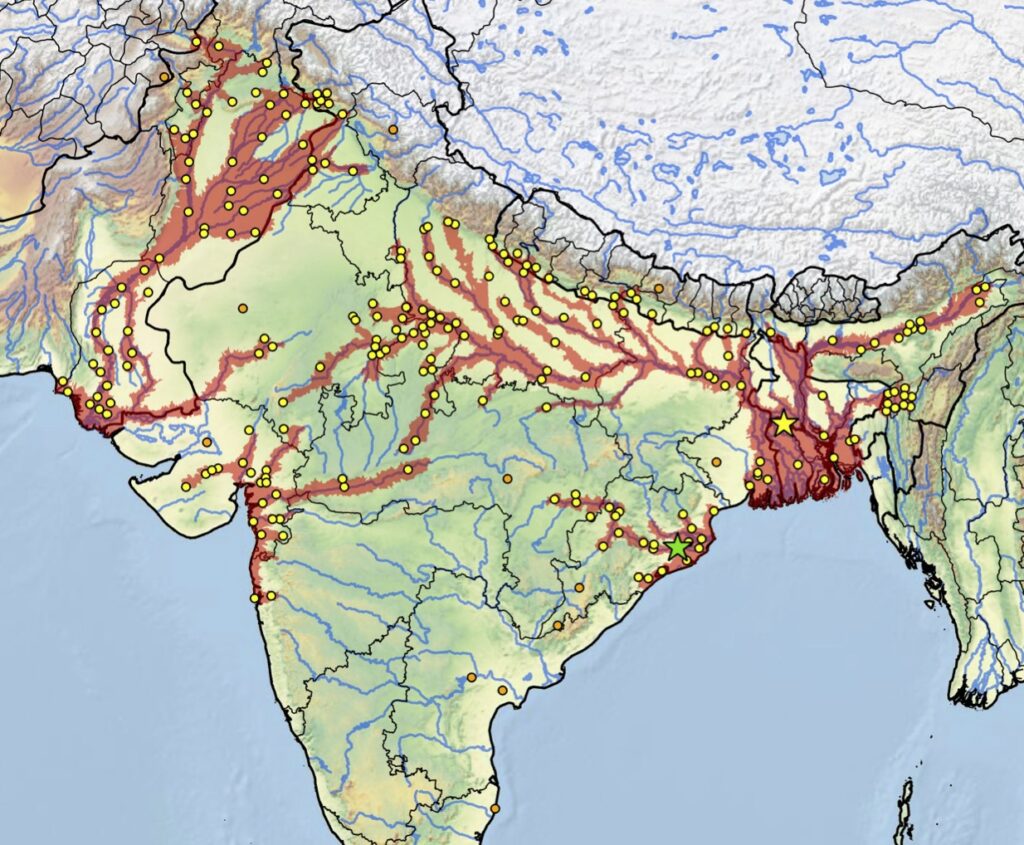
Estimated historical indigenous distribution of Nilssonia gangetica in South Asia (Afghanistan, Bangladesh, India, Nepal, and Pakistan). Yellow dots = museum and current and historical occurrence records of presumed native populations based on literature and online records (TTWG 2025); orange dots = presumed trade-related or other translocated non-native records; yellow star = estimated type locality for Nilssonia gangetica (Cuvier 1825; TTWG 2025); green star = restricted type locality for Trionyx gangeticus mahanaddicus Annandale 1912. Colored shading = estimated historical indigenous range. Distribution is based on fine-scaled GIS-defined level 12 HUCs (hydrologic unit compartments) constructed around localities and then adding HUCs that connect point localities in the same watershed or physiographic region, and similar habitats and elevations as verified HUCs, based on TTWG (2021, 2025) and adjusted based on data from the authors. Map by Chelonian Research Foundation.
Synonymy
Trionyx gangeticus Cuvier 1825, Aspidonectes gangeticus, Tyrse gangetica, Isola gangetica, Aspideretes gangeticus, Amyda gangetica, Nilssonia gangetica, Nilssonia gangetica gangetica, Trionyx javanicus Gray 1830 (partim, junior homonym), Tyrse javanica, Gymnopus duvaucelii Duméril and Bibron 1835 (partim, nomen novum), Trionyx gangeticus mahanaddicus Annandale 1912, Nilssonia gangetica mahanaddica, Trionyx gangeticus mahanadicus Das, Dattagupta, and Gayen 1998 (nomen invalidum).
Subspecies
None currently recognized.
Conservation Status
Last Updated on: 13 August 2026
Legal Status
Last Updated on: 13 August 2026
Citation
Rao, R.J. and Ahmed, M.F. 2026. Nilssonia gangetica (Cuvier 1825) – Indian Softshell Turtle, Ganges Softshell Turtle. In: Rhodin, A.G.J., Iverson, J.B., van Dijk, P.P., Stanford, C.B., Goode, E.V., Buhlmann, K.A., and Mittermeier, R.A. (Eds.). Conservation Biology of Freshwater Turtles and Tortoises: A Compilation Project of the IUCN/SSC Tortoise and Freshwater Turtle Specialist Group. Chelonian Research Monographs 5(20):138.1–13. doi: 10.3854/crm.5.138.gangetica.v1.2026; www.iucn-tftsg.org/cbftt/.