
Summary
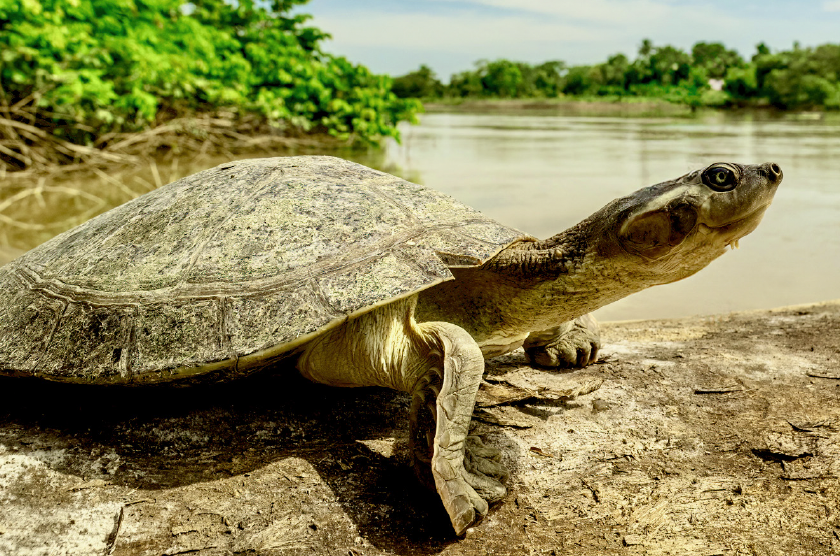
The Magdalena River Turtle, Podocnemis lewyana (family Podocnemididae), is a medium- to large-sized, sexually dimorphic endemic species of Colombia found in the Sinú and Magdalena drainages (including the lower Cauca, San Jorge, and Nechí tributaries). Females reach a maximum straight-line carapace length (SCL) of 50.0 cm, and males reach a maximum SCL of 42.4 cm. Females take 5–7 years to reach sexual maturity at approximately 27–30 cm SCL, while males appear to mature reproductively at around 3–4 years old, with an SCL of approximately 19–20 cm. The species has a relatively long generation time (10–12 years), implying that depleted populations are only slowly replaced and have a low capacity for recovery after a decline. Nesting occurs twice a year on exposed sandbars and beaches in December–February and July–August, with clutch size typically ranging from 12–22 eggs, with larger females laying up to 32 eggs. Eggs hatch after approximately 61 days (range = 52–89), with hatchlings averaging 4.2–4.6 cm SCL. Historically, eggs and meat of P. lewyana have been used by local communities as a source of protein. However, continued unsustainable capture of adults, excessive egg collection, and illegal trade have resulted in declines in distribution and population size across its range. In the Magdalena River basin, there are no government-designated protected areas that effectively control or mitigate these threats, thereby increasing the species’ vulnerability. Genomic-scale genetic analysis has revealed marked population structure, with significant genetic differentiation between populations, especially between the Sinú and Magdalena drainages, and within the Magdalena drainage due to isolation-by-distance, yielding three distinct management units for the species. Podocnemis lewyana is an obligately aquatic, herbivorous species that consumes a wide variety of aquatic and terrestrial plant species; therefore, it probably plays a functionally important role as a seed disperser and germination facilitator, as well as being an important component of the nutrient cycling in its ecosystems.
Distribution
Colombia. Restricted to the Sinú, San Jorge, Cauca, and Magdalena river drainages in northwestern Colombia. It is the only Podocnemididae species found northwest of the Andes Mountains, and occurs in 13 departments of Colombia: Antioquia, Atlántico, Bolívar, Boyacá, Caldas, Cesar, Córdoba, Cundinamarca, Huila, Magdalena, Santander, Sucre, and Tolima.
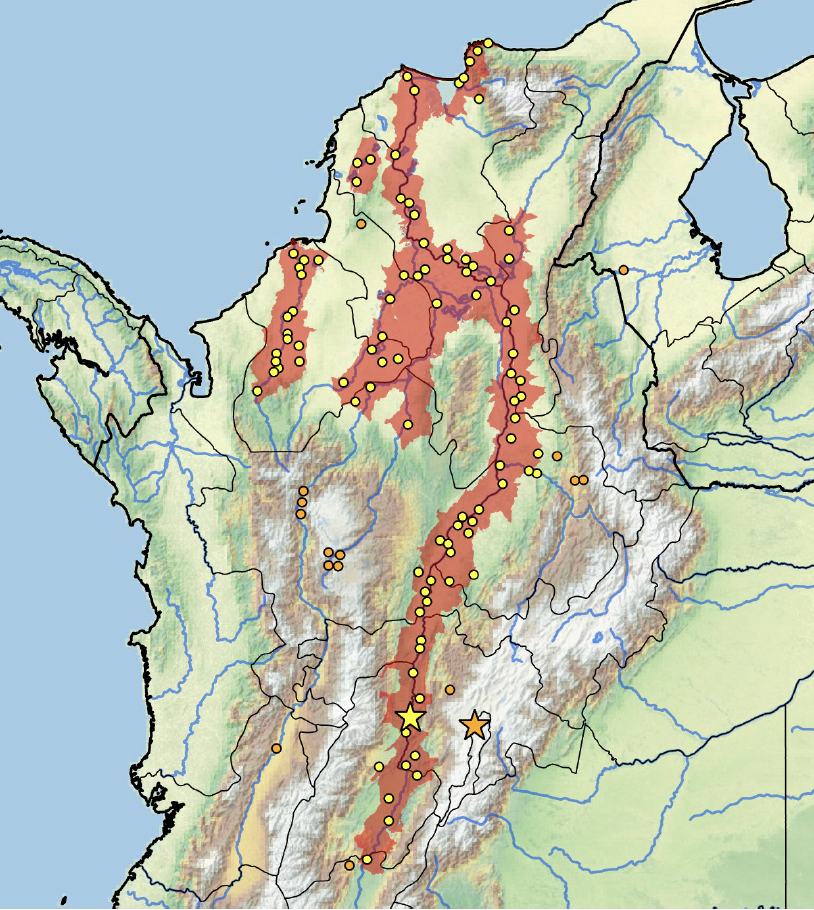
Estimated historical indigenous distribution of Podocnemis lewyana in Colombia. Yellow dots = museum and current and historical occurrence records of presumed native populations based on literature and online records (Páez et al. 2009a; TTWG 2025); orange dots = presumed trade-related or other translocated or introduced non-native records; yellow star = restricted type locality (TTWG 2025); orange star = erroneously restricted type locality (Williams 1954; TTWG 2025). Colored shading = estimated historical indigenous range. Distribution is based on fine-scaled GIS-defined level 12 HUCs (hydrologic unit compartments) constructed around localities and then adding HUCs that connect point localities in the same watershed or physiographic region, and similar habitats and elevations as verified HUCs, based on TTWG (2025) and adjusted based on data from the authors. Map by Chelonian Research Foundation.
Synonymy
Podocnemis lewyana Duméril 1852.
Subspecies
None recognized.
Conservation Status
Last Updated on: 17 August 2026
Legal Status
Last Updated on: 17 August 2026
Citation
Páez, V.P., Bock, B.C., Gallego-García, N., Vargas-Ramírez, M., and Forero-Medina, G. 2026. Podocnemis lewyana Duméril 1852 – Magdalena River Turtle, Tortuga del Río Magdalena. In: Rhodin, A.G.J., Iverson, J.B., van Dijk, P.P., Stanford, C.B., Goode, E.V., Buhlmann, K.A., and Mittermeier, R.A. (Eds.). Conservation Biology of Freshwater Turtles and Tortoises: A Compilation Project of the IUCN/SSC Tortoise and Freshwater Turtle Specialist Group. Chelonian Research Monographs 5(20):139.1–14. doi: 10.3854/crm.5.139.lewyana.v1.2026; www.iucn-tftsg.org/cbftt/.