Summary
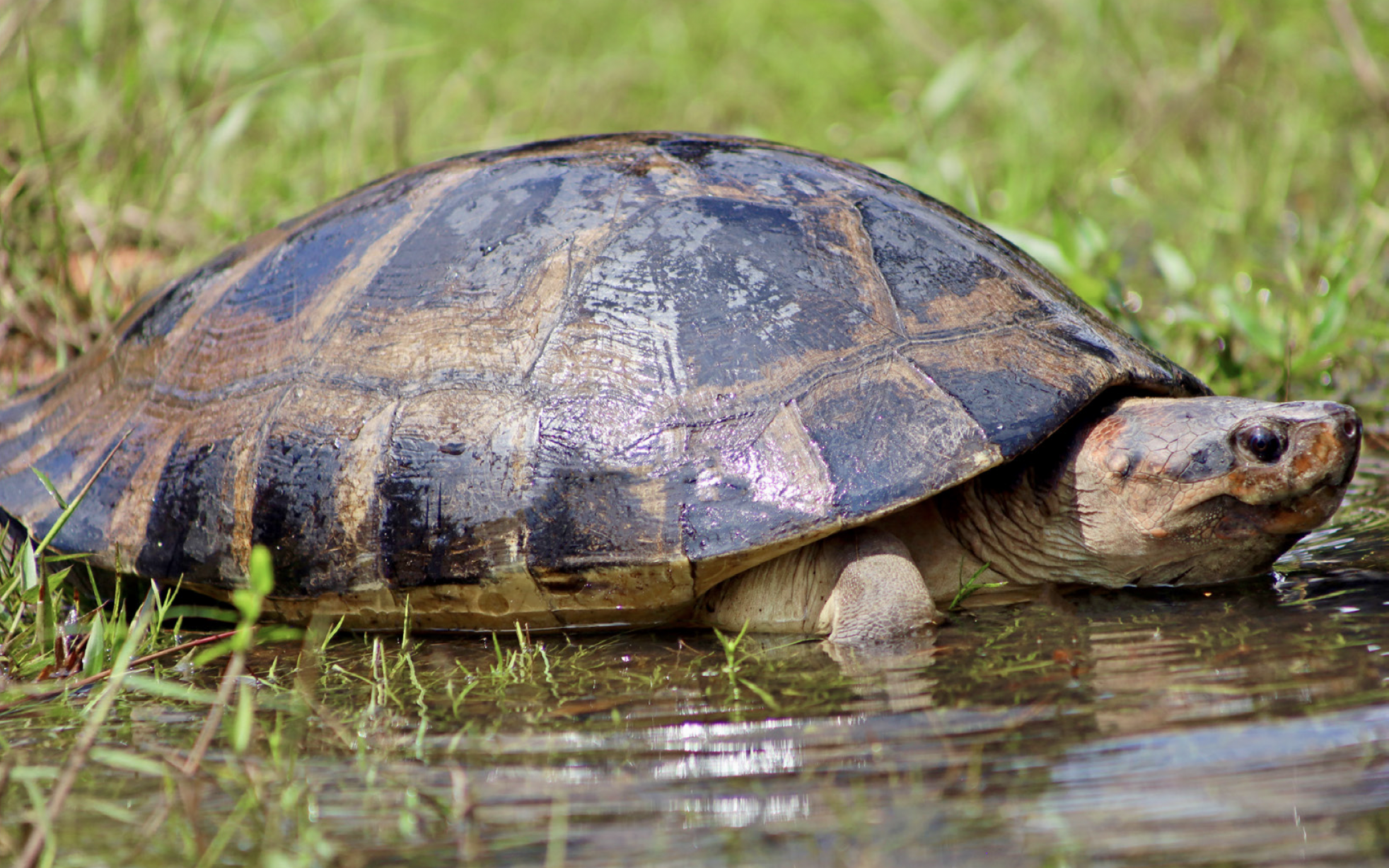
The Malaysian Giant Turtle, Orlitia borneensis (family Geoemydidae), is a large freshwater species native to Southeast Asia and listed on the IUCN Red List as Critically Endangered. The species is very poorly known with almost no studies on wild populations. In general, O. borneensis is a relatively nondescript aquatic species that inhabits large rivers and streams in swamp-forest habitats across lowland, coastal regions. Orlitia borneensis typically has a patternless, dark-colored carapace and dorsal skin (with some variation), and a tan plastron and pale ventral skin. It is one of the largest freshwater turtle species in tropical Southeast Asia, with a wide range of reported maximum straight-line carapace lengths (SCL) from an estimated 76.3 cm to 117 cm, but most individuals are about 40–60 cm SCL, with males usually larger than females. It has been reported to lay at least one clutch of 6–12 brittle, elongate eggs annually in April–June, which average about 80 x 40 mm in size. Orlitia borneensis seems to consume mainly vegetation in the wild, especially fallen forest fruits and aquatic plants, but may also opportunistically feed on fish and aquatic invertebrates. The species is heavily exploited for human consumption throughout most of its range. Enforcement of existing laws and status surveys of this species in the wild are urgently needed.
Distribution
Indonesia (Kalimantan, Sumatra), Malaysia (West Malaysia, Sabah, Sarawak), Singapore. Orlitia borneensis occurs in lowland river systems throughout the Sundaland region of Southeast Asia, including West Malaysia, Singapore, and on the major islands of Borneo and Sumatra. On Borneo, it is found in southwestern Sarawak, the lowlands of Kalimantan, and in Sabah. Many of the smaller islands between these larger land masses also harbor populations, such as Belitung and Bangka, where the species has recently been reported.
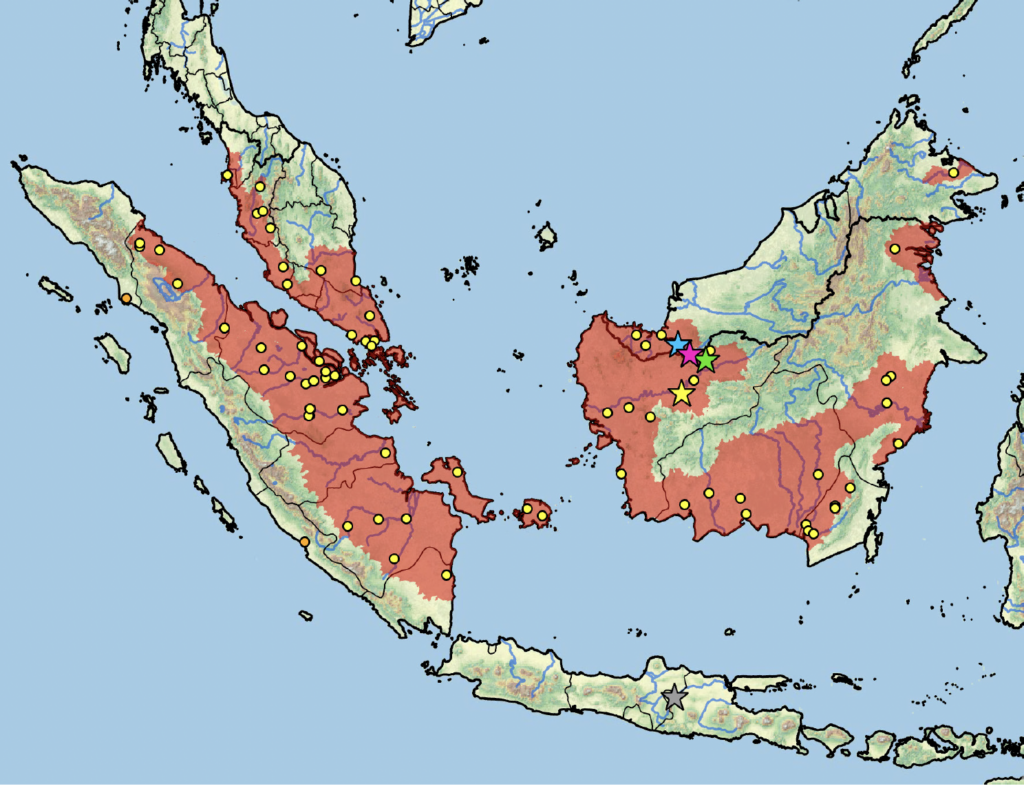
Estimated historical indigenous distribution of Orlitia borneensis in Indonesia and Malaysia. Yellow dots = museum and current and historical occurrence records of presumed native populations based on literature and online records (TTWG 2025; in prep.); orange dots = presumed trade-related or other translocated or introduced non-native records; yellow star = type locality for Cistudo borneensis Bleeker 1857 (nomen nudum) and restricted type locality for Orlitia borneensis Gray 1873; green star = type locality for Clemmys (Heteroclemmys) gibbera Peters 1874; blue star = type locality for Hardella baileyi Bartlett 1895; pink star = type locality for Liemys inornata Boulenger 1897; gray star = type locality for Batagur signatus † Jaekel 1911 (TTWG 2025). Colored shading = estimated historical indigenous range. Distribution is based on fine-scaled GIS-defined level 12 HUCs (hydrologic unit compartments) constructed around localities and then adding HUCs that connect point localities in the same watershed or physiographic region, and similar habitats and elevations as verified HUCs, based on TTWG (2025) and adjusted based on subsequent data (TTWG, in prep.) and from the authors. Map by Chelonian Research Foundation.
Synonymy
Cistudo borneensis Bleeker 1857 (nomen nudum), Orlitia borneensis Gray 1873, Bellia borneensis, Clemmys (Heteroclemmys) gibbera Peters 1874, Clemmys gibbera, Heteroclemmys gibbera, Hardella baileyi Bartlett 1895, Brookeia baileyi, Adelochelys crassa Baur 1896, Liemys inornata Boulenger 1897, Batagur signatus † Jaekel 1911.
Subspecies
None recognized.
Conservation Status
Last Updated on: 25 September 2026
Legal Status
Last Updated on: 25 September 2026
Citation
Hughes, D.F., Auliya, M., Chen, P.N., Hardian, A.B., Hasan, V., Jayanto, H., Nurfi’aini, C., Rahmawati, I.P., Rusli, N., Sukmawati, J.G., Tirtayani, J.V., and Moll, E.O. 2026. Orlitia borneensis Gray 1873 – Malaysian Giant Turtle, Bornean River Turtle, Kura-Kura Byuku, Kura-Kura Raksasa. In: Rhodin, A.G.J., Iverson, J.B., van Dijk, P.P., Stanford, C.B., Goode, E.V., Buhlmann, K.A., and Mittermeier, R.A. (Eds.). Conservation Biology of Freshwater Turtles and Tortoises: A Compilation Project of the IUCN/SSC Tortoise and Freshwater Turtle Specialist Group. Chelonian Research Monographs 5(20):140.1–25. doi: 10.3854/crm.5.140.borneensis.v1.2026; www.iucn-tftsg.org/cbftt/.